



How Safe Is the 2026 Ford Maverick?

What Car Shoppers Need to Know
- 2026 Ford Maverick earned top marks in two out of three Insurance Institute for Highway Safety crash tests
- The Maverick was disqualified from Top Safety Pick honors by the results of its moderate overlap frontal crash test.
- Recently revised moderate overlap test is a common stumbling block for automakers
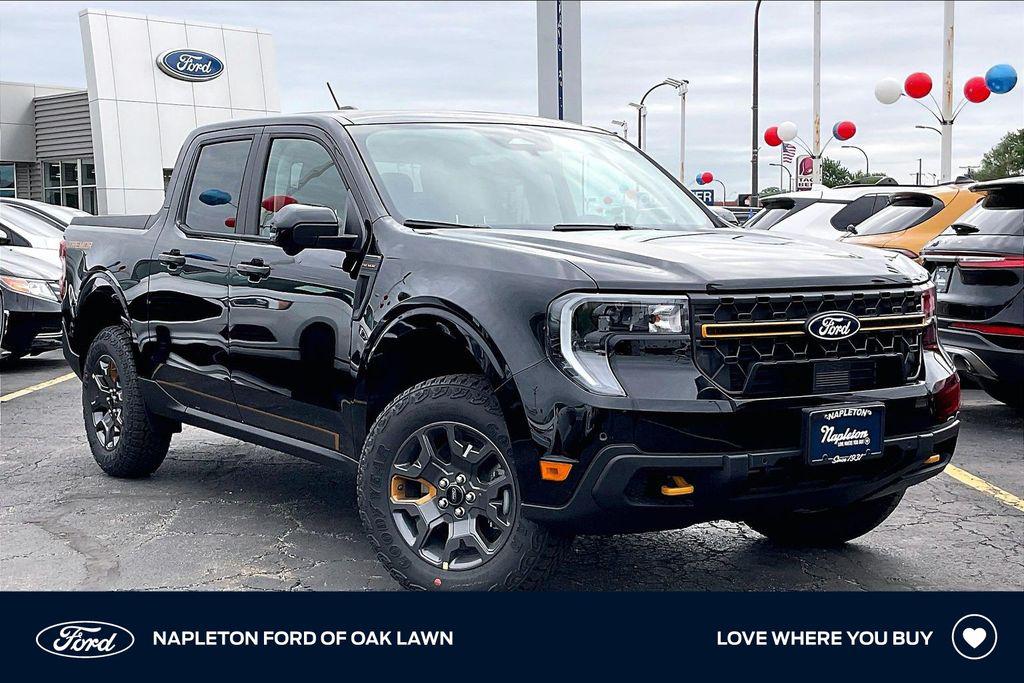
The compact 2026 Ford Maverick is an affordable, fuel-efficient and generally safe pickup truck. In testing by the Insurance Institute for Highway Safety, the Maverick performed admirably in most measures, missing out on a Top Safety Pick award due to a single evaluation.
Related: 2025 Ford Maverick Hybrid and Lobo Review: The People’s Perfect Truck
Shop the 2026 Ford Maverick near you
-

$33,533
New 2026 Ford Maverick -
$39,164
New 2026 Ford Maverick -

$31,158
New 2026 Ford Maverick -

$36,770
New 2026 Ford Maverick -

$32,411
New 2026 Ford Maverick -

$38,913
New 2026 Ford Maverick
Maverick Crash-Test Scores
IIHS subjects vehicles to three crash tests: two frontal crashes and a side impact. They also rate vehicles on how well their headlights illuminate a dark road and how effectively their crash prevention systems avoid collisions with other vehicles and pedestrians. Vehicles are scored in all tests on a scale of good, acceptable, marginal or poor.
Crashworthiness
- Rating for small overlap front: good
- Rating for moderate-overlap front, updated test: marginal
- Rating for side impact, updated test: good
The small overlap front crash test is meant to simulate a collision in which the vehicle leaves the road and strikes a tree or utility pole. In it, the vehicle travels at 40 mph into a rigid barrier that covers 25% of its width. The test is conducted once on the driver’s side of the vehicle and once on the passenger’s side. For the driver-side test, a dummy representing an average adult male is in the driver’s seat. For the passenger’s side test, a second identical dummy sits in the front passenger seat. Results from the two tests are compiled into a single rating.
The moderate overlap front crash test simulates a different common type of crash, in which a vehicle crosses the centerline and strikes another vehicle traveling the other direction. For this test, the vehicle is accelerated to 40 mph and strikes a barrier with a deformable honeycomb face that covers 40% of the vehicle’s width. The forces in this test approximate an offset head-on collision in which each vehicle is traveling just below 40 mph. A dummy representing an average adult male is again in the driver’s seat for this test, with one representing a 12-year-old child or a small adult female in the seat behind the driver.
The side test recreates a T-bone collision. The driver’s side of the subject vehicle is struck by a 4,200-pound sled the approximate height of a modern SUV that is traveling at 37 mph. Crash-test dummies representing a 12-year-old child or a small adult female are buckled into the driver’s seat and the driver’s side rear seat.
Crash Avoidance and Mitigation
- Rating for headlights (varies by trim/option): good, acceptable
- Rating for front crash prevention, vehicle-to-vehicle 2.0, standard system: acceptable
- Rating for front crash prevention, pedestrian, standard system: good
The agency’s headlight evaluation measures how well the headlights illuminate a dark road on straightaways as well as in gentle and sharp curves to both the right and the left. It also quantifies the amount of glare headlights will cause for oncoming drivers. If multiple headlight options are available, IIHS tests each one separately.
Multiple versions of the vehicle-to-vehicle collision avoidance test gauge the subject’s ability to detect and prevent (or mitigate) rear-end collisions with cars, motorcycles and heavy trucks. IIHS records the timing of any audible alert as well as when any automatic emergency braking occurs and how much it slows the vehicle before impact or if it prevents impact entirely.
The pedestrian test measures the subject vehicle’s ability to detect and prevent potential collisions with pedestrians. This rating also incorporates results from multiple tests, with evaluations conducted in daylight and at nighttime, with dummies representing children and adults both crossing the street perpendicular to the vehicle’s direction of travel as well as walking near the edge of the road with traffic.
Versus Competitors
The 2026 Ford Maverick outperforms many — but not all — other compact and mid-size pickup trucks. In order to qualify for a Top Safety Pick award, vehicles must earn a good rating in all three crash tests, as well as at least an acceptable in the headlight and pedestrian detection tests. There is no requirement for the vehicle-to-vehicle crash prevention test to qualify for Top Safety Pick.
There is, however, a vehicle-to-vehicle crash-test result requirement for Top Safety Pick+, IIHS’ highest honor. To qualify as a Top Safety Pick+, vehicles need to rate at least acceptable in the vehicle-to-vehicle test and earn the highest score, good, in the pedestrian-avoidance test.
The Maverick missed out on Top Safety Pick in the moderate overlap frontal crash test, where it scored a marginal due to the dummy in the rear seat indicating increased risk of head and abdominal injuries. It should also be noted that while the Hyundai Santa Cruz qualified as a Top Safety Pick in 2025, the criteria for that award have changed for 2026. Vehicles must now earn a good rating in all three crash tests and the Santa Cruz rated only acceptable in the moderate overlap front crash test, so it does not qualify under the new criteria.
| Vehicle | Award | Small Overlap Front | Moderate Overlap Front | Side | Headlights | FCPV* | FCPP* |
| 2026 Ford Maverick | None | G | M | G | G | A | G |
| 2026 Honda Ridgeline | None | A | P | G | M | P | P |
| 2026 Nissan Frontier crew cab | None | G | G | A | A | P | A |
| 2026 Hyundai Santa Cruz (2025 methodology) | Top Safety Pick | G | A | G | G | M | A |
*FCPV stands for Front Crash Prevention: Vehicle; FCPP stands for Front Crash Prevention: Pedestrian.
Read More About the Ford Maverick on Cars.com:
- How Do Car Seats Fit in a 2025 Ford Maverick?
- Ford Maverick 300T Is a SEMA Street-Truck Special You Can Build
- What’s the 2026 Ford Maverick’s MPG?
- What’s the 2025 Ford Maverick Lobo Like on a Track?
- Research the Ford Maverick
- Add Cars.com as a Preferred Source on Google
Related Video:
Cars.com’s Editorial department is your source for automotive news and reviews. In line with Cars.com’s long-standing ethics policy, editors and reviewers don’t accept gifts or free trips from automakers. The Editorial department is independent of Cars.com’s advertising, sales and sponsored content departments.