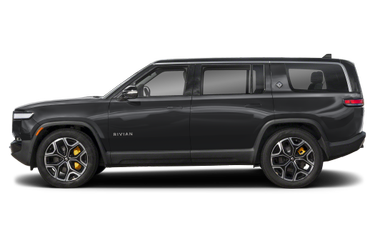









What Car Shoppers Need to Know
- The Rivian R1S is a mid-size electric SUV with three rows of seats.
- It’s available with two, three or four motors, with all-wheel drive standard.
- Pricing starts at $85,885 (all prices include the destination charge).
The all-new two-row R2 SUV has been in Rivian’s spotlight recently, but the R1S mid-size SUV — and its pickup truck twin, the R1T — paved the way for the smaller R2. Structurally identical, and visually identical forward of the rear doors, the larger Rivians share the same battery packs and motors, but where the R1T carves out its own niche as a plush pickup, the R1S SUV lands in the heart of the family-hauler market with three rows and seven seats.
What’s New for 2026?
The maximum-madness four-motor R1S took a brief hiatus when the SUV was updated last year, but it’s back for 2026. It previously made an already astounding 835 horsepower and 908 pounds-feet of torque, but for 2026, those figures rocket to 1,025 hp and 1,198 pounds-feet of torque, featuring the second-generation R1S’ updated motors. Rivian’s new Autonomy+ hands-free driving technology is now optional on every R1S; in addition to limited-access freeways, it will now also operate, Rivian says, on some 3.5 million miles of two-lane roads, as well. Standard across the line for 2026 is a new North American Charging Standard port that allows drivers to plug in at Tesla Superchargers and other compatible charging stations.
Pricing
The R1S is priced higher than most similarly sized electric SUVs, but it’s one of the few electric vehicles in this class to come standard with three rows of seats. It also costs less than gas-powered luxury three-row SUVs like the BMW X7 and Mercedes-Benz GLS. The following prices are correct as of July 2026 (manufacturers sometimes change a vehicle’s pricing over the course of a model year):
- Dual Motor: $85,885
- Tri Motor: $108,885
- Quad Motor: $123,885
Trims and Features
The new Autonomy+ option doesn’t add any new sensors or hardware to the R1S. Like Tesla’s Full Self Driving (Supervised), it integrates existing inputs and programs them to work better together, incorporating over-the-air updates for continual refinement. Therefore, standard equipment on every R1S includes a comprehensive suite of safety technologies enabled by 11 cameras and 12 ultrasonic sensors: forward collision warning with automatic emergency braking, adaptive cruise control, blind spot warning, lane-centering steering assist, rear cross-traffic alert, a 360-degree camera system and automatic high beams. Autonomy+ itself is a $2,500 option with no ongoing fees.
Dual Motor
The entry-level R1S Dual Motor doesn’t skimp on comfort, luxury or tech features. An adjustable-height air suspension and 22-inch wheels are standard, as are LED exterior lighting, rain-sensing windshield wipers, a panoramic moonroof, onboard air compressor, and keyless entry and start. Inside are power-adjustable front seats with heating and ventilation, a heated steering wheel with a power tilt/telescoping column, and dual-zone automatic climate control. Cabin tech includes a 12.3-inch digital instrument cluster, 15.6-inch touchscreen with navigation, dual wireless phone-charging pads and a 6.8-inch backseat touchscreen.
Tri Motor and Quad Motor
On top of the already loaded Dual Motor’s content, the Tri Motor adds a greater range of adjustment for ride height, an electrochromic panoramic moonroof that varies its opacity at the touch of a button, more paint color choices, more drive modes and an 18-speaker audio system. Beyond a fourth motor, the only additional equipment on the Quad Motor is increased underbody protection.
Powertrains, Estimated Driving Range and Charging Speed
The only R1S to offer a choice of battery packs is the entry-level Dual Motor, which can be had with the Large or Max battery. The Max battery is standard on the Tri Motor and Quad Motor. The Dual Motor is also the only R1S available with a Performance Upgrade Package, which increases output from 533 hp and 610 pounds-feet of torque to 665 hp and 829 pounds-feet with no impact on range.
Every Rivian R1S makes thrilling use of its power: The Dual Motor is quick, accelerating from 0-60 mph in 4.5 seconds, while the Tri and Quad Motors are blindingly quick: Rivian says they can go from 0-60 in 2.9 and 2.6 seconds, respectively. The figures below are for each version when equipped with their standard 22-inch wheels.
|
Model |
Output, Powertrain |
Range (Miles) |
Charging Speed (Kilowatts) |
|
Dual Motor, Large battery |
533 hp, two electric motors (one front, one rear) |
329 |
215 |
|
Dual Motor, Max battery |
533 hp, two electric motors (one front, one rear) |
410 |
215 |
|
Tri Motor |
850 hp, three electric motors (one front, two rear) |
371 |
215 |
|
Quad Motor |
1,025 hp, four electric motors (two front, two rear) |
374 |
215 |
Interior
Rivian doesn’t offer the diverse palette of interior colors and materials that some of its competitors do, but its limited choices are well curated; the cabin is handsomely designed and constructed of high-quality materials. There’s plenty of room in the first and second rows of seats, but the third row is a kids-only proposition in terms of both space and accessibility. And in today’s luxury market, it’s a miss to not even offer heated and ventilated second-row seats as an option. Speaking of misses, Apple CarPlay and Android Auto — either wired or wireless — aren’t available in the R1S.
Versus the Competition
Now that the R1S is in its fifth model year, it finally has a meaningful number of competitors. Most notable among them is the Lucid Gravity, which is another three-row SUV from an American EV startup. Whereas the Rivian appeals to buyers’ proven taste for boxy SUVs, the Lucid’s low-slung, aerodynamic shape daringly suggests “minivan.” The Gravity’s cavernous second-row seat offers minivan-like space, but the third row is similar to the Rivian’s. The Lucid can be had with heated second-row seats, but it tops out at a “wimpy” 828 hp and 909 pounds-feet of torque.
Shoppers looking for an alternative from a more familiar brand might want to check out the Cadillac Vistiq or Mercedes-EQ EQS SUVs. Like the Gravity, both are focused on on-road luxury rather than rugged-terrain adventuring. The maximum EPA-estimated driving ranges of the Cadillac and Mercedes (305 and 317 miles, respectively) are, however, shorter than the ranges in most versions of the R1S.
Though they aren’t technically luxury vehicles, the upper trims of the Hyundai Ioniq 9 and Kia EV9 are compelling three-row electric SUVs that stack up well with the R1S as everyday family haulers.
Do We Like the Rivian R1S?
The Rivian R1S is an outstanding luxury SUV. Its cabin is attractive and comfortable, with a truly upscale feel to its materials that justifies its price tag. For car enthusiasts, the R1S’ appeal extends beyond just the monstrous power it can bring: This 3-ton-plus electric SUV is genuinely fun to drive, with excellent balance and lively steering. The downside is that even with a high-tech suspension comprising air springs and a hydraulic roll-control system, the ride on the standard 22-inch wheels is fairly stiff.