







What Car Shoppers Need to Know
- The BMW X1 is a compact luxury SUV with standard all-wheel drive.
- Two versions of BMW’s turbocharged four-cylinder engine are available.
- Pricing starts at $44,550 (all prices include destination).
BMW’s smallest and most affordable SUV, the X1 looks like a shrunken X5, but it actually shares its basic architecture with the Mini lineup. (Mini is a subsidiary of BMW.) Whereas front-wheel drive is standard on many Minis, however, the X1 is exclusively AWD. It’s one of the cheapest BMWs you can buy, yet it doesn’t skimp on the premium experience buyers expect from the brand. The X1 is roomy, quick and athletic. If you like it but want racier styling, BMW also makes the X2, a version of the X1 with a sleeker, coupelike roofline.
What’s New for 2026?
The only changes to the X1 for 2026 are new colors.
Pricing
The X1 offers the look and feel of its more expensive siblings at a tremendous savings: It’s more than $8,000 cheaper than the next size up in BMW’s SUV family, the X3, but has similar power and acceleration with the standard engine. (The X3’s optional engine is significantly more potent than the X1’s.)
BMW doesn’t sell multiple trim levels of its vehicles the way most manufacturers do. Instead, it offers numerous comfort, luxury and tech features — both in packages and as stand-alone options — on models that have different engines but largely similar standard equipment. The following prices are correct as of June 2026. (Manufacturers sometimes change a vehicle’s pricing over the course of a model year.)
- xDrive28i: $44,550
- M35i: $53,750
Trims and Features
The standard safety suite on both versions of the X1 includes forward collision warning with automatic emergency braking, adaptive cruise control, blind spot warning, lane departure steering assist, front and rear parking sensors, and automated parking.
Optional safety technologies on the X1 include semi-autonomous highway driving, emergency steering assist, a 360-degree camera system and a head-up display.
xDrive28i
The X1 xDrive28i rides on 18-inch wheels and features LED front lighting, rain-sensing windshield wipers, a power liftgate, keyless entry and start, and digital key capability, which allows owners to use a smartphone as a vehicle key and for remote monitoring. Inside, the xDrive28i includes synthetic leather upholstery, heated and power-adjustable front seats, dual-zone automatic climate control and ambient lighting. In-car tech includes a 10.25-inch digital instrument cluster and a 10.7-inch touchscreen with navigation, Apple CarPlay, Android Auto and wireless phone charging.
M35i
Beyond its more powerful engine, the X1 M35i also features a sport suspension with adaptive dampers, 19-inch wheels, and upgraded brakes with blue calipers. Its more aggressive styling includes unique front and rear bumpers, sill panels and black exterior trim. It also gains paddle shifters and a Harman Kardon audio system.
Powertrains and Fuel Economy
Both X1s are powered by turbocharged 2.0-liter four-cylinder engines paired with seven-speed dual-clutch automatic transmissions and standard AWD. The xDrive28i’s four-cylinder makes 241 horsepower and 295 pounds-feet of torque. In the M35i, torque output is unchanged, but horsepower increases to 312. BMW says the xDrive28i will accelerate from 0- 60 mph in 6.2 seconds, while the M35i needs just 5.2 seconds to get there. The 28i returns an EPA-rated 25/34/28 mpg city/highway/combined and the M35i is rated at 24/32/27 mpg.
| Trim | Powertrain | City MPG | Highway MPG | Combined MPG |
| xDrive28i | Turbo 2.0-liter four-cylinder | 25 | 34 | 28 |
| M35i | Turbo 2.0-liter four-cylinder | 24 | 32 | 27 |
Interior
The pricier BMW X3 is 10 inches longer than the X1, but the X1 has slightly more room in both its front and rear seats. That’s a low bar, though, and taller adults will still find the X1’s backseat rather short on legroom. The X1 has less cargo space than the bigger X3, but the 25.7 cubic feet behind its rear seats expands to 57.2 with them folded. Both figures are large for the class.
The X1’s interior design is crisp and modern, and BMW offers several upholstery colors and trim options to personalize it. BMW integrates the X1’s digital dashboard and infotainment touchscreen into a single attractive display, which is curved and angles slightly toward the driver.
Versus the Competition
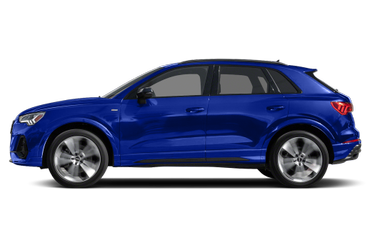
The X1’s primary rivals are also European. The Audi Q3 has been redesigned for 2026, gaining more horsepower and new tech features, and offers a similarly sporty feel. The Mercedes-Benz GLA-Class has a more reserved look and a similarly tech-focused interior. The Volvo XC40 is less overtly sporty, but it has surprisingly good interior space for its tidy dimensions.
Do We Like the BMW X1?
We do. The BMW X1 is lively and entertaining but still comfortable. We noticed some harsh impacts with potholes in the X1, but the version we drove was fitted with 19-inch wheels and the SUV’s standard suspension. The standard 18-inch wheels or available adaptive dampers would likely smooth things out a bit. The X1 is also among the more efficient AWD SUVs in its class.