





2002
Kia Sedona

Starts at:
$18,995
Shop options
New 2002 Kia Sedona
See ratings
Not rated
Consumer rating
Owner reviewed vehicle score
Not rated
Safety rating
NHTSA tested vehicle score
Not rated
Consumer rating
Owner reviewed vehicle score
Not rated
Safety rating
NHTSA tested vehicle score
Shop Cars.com
Browse cars & save your favorites
Dealers near you
Find & contact a dealership near you
no listings

We're not finding any listings in your area.
Change your location or search Cars.com to see more!

Change location

Available trims

See the differences side-by-side to compare trims.
  • 4dr Auto LX
    Starts at
    $18,995
    15 City / 20 Hwy
    MPG
    7
    Seat capacity
    Gas V6
    Engine
    Front Wheel Drive
    Drivetrain
    See all specs
  • 4dr Auto EX
    Starts at
    $20,995
    15 City / 20 Hwy
    MPG
    7
    Seat capacity
    Gas V6
    Engine
    Front Wheel Drive
    Drivetrain
    See all specs

Photo & video gallery

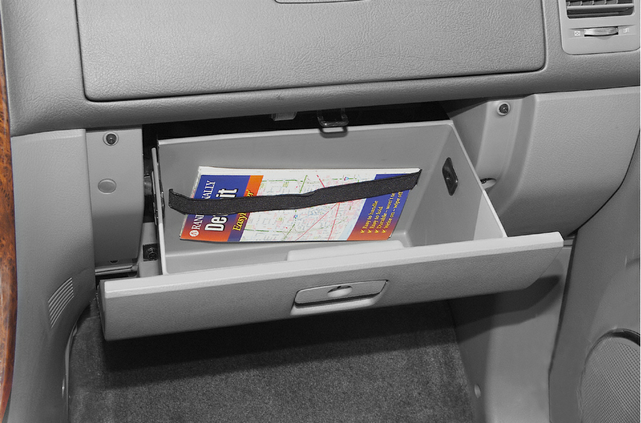
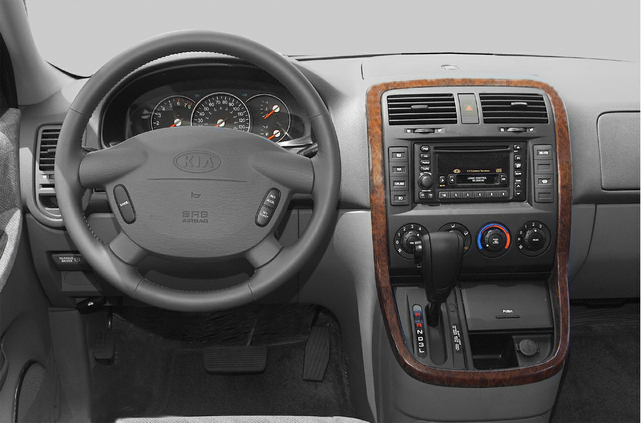
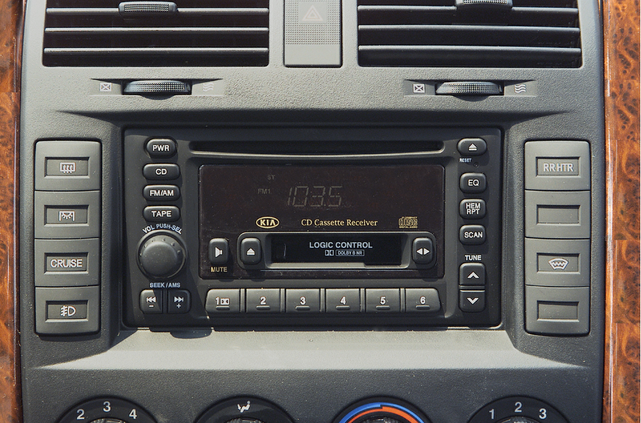
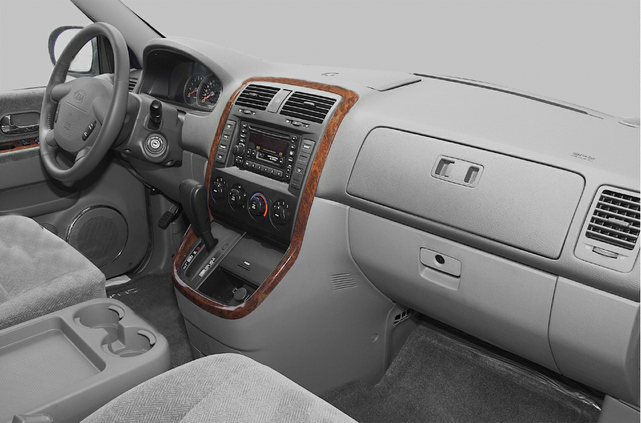
2002 Kia Sedona 2002 Kia Sedona 2002 Kia Sedona 2002 Kia Sedona 2002 Kia Sedona 2002 Kia Sedona 2002 Kia Sedona 2002 Kia Sedona 2002 Kia Sedona 2002 Kia Sedona 2002 Kia Sedona 2002 Kia Sedona 2002 Kia Sedona 2002 Kia Sedona 2002 Kia Sedona

The good & the bad

This vehicle doesn't have any good or bad insights yet.

Use our comparison tool to look at this model side-by-side with other vehicles or view the full specifications list .

Start your comparison

Expert 2002 Kia Sedona review

our expert's take
Our expert's take
By
Full article
our expert's take

Tell folks your ride is a Kia, and they’re likely to arch an eyebrow.

Then a faint glimmer of recognition – ah, the pint-sized SUV – Sportage. Nope. Oh, yeah, that new Optima sedan. Wrong again, weak link.

The last thing with which they’re likely to associate the name is a minivan, for this is the first minivan to originate in South Korea, Kia’s home, and was just introduced for the 2002 model year. It’s not mini in the sense of tiny, either, but rather in the accepted sense of garageable, unlike those things that make runs to the airport.

In size, the Sedona lies between the standard-wheelbase Dodge Caravan and the extended wheel-base version of that archetypal soccer-mom mount.

To which, it can accommodate 7 people, assuming the median age isn’t too high, stretching 194 inches overall. The axles are 114 inches apart.

It stands 5 feet, 9 inches high, so it’s neither cute nor overwhelming, and offers a driving position that is the No. 1 thing many people love about SUVs and minivans: raised above the passenger-car riff-raff.

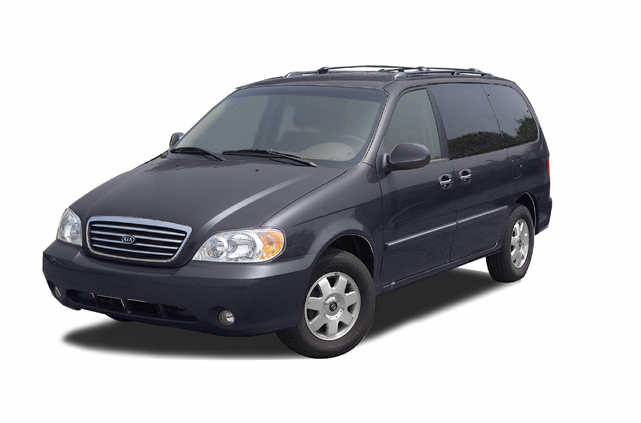
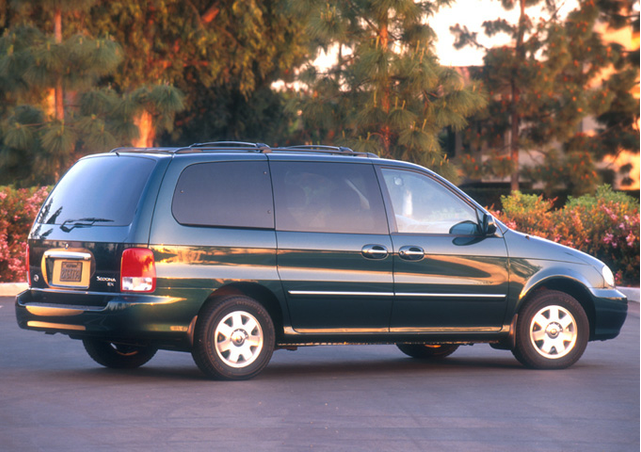
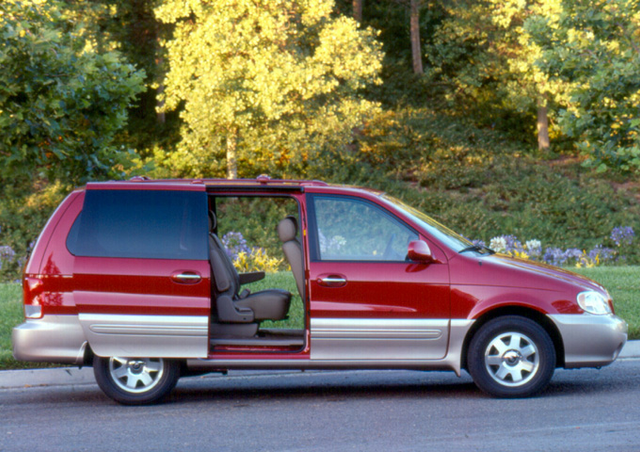
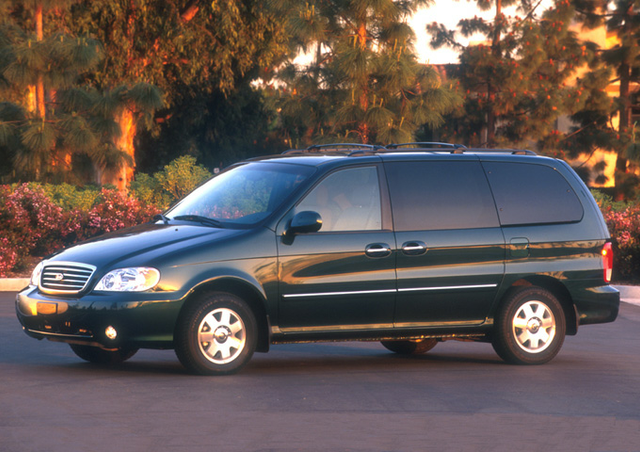
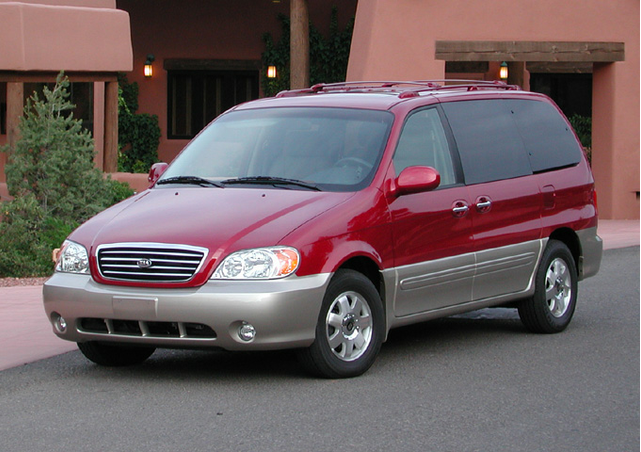
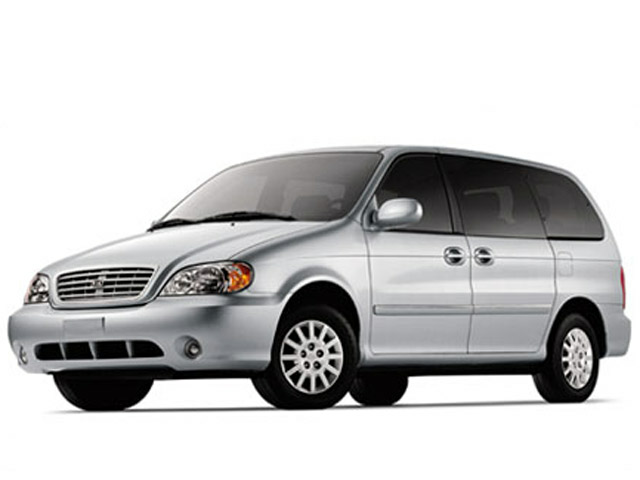
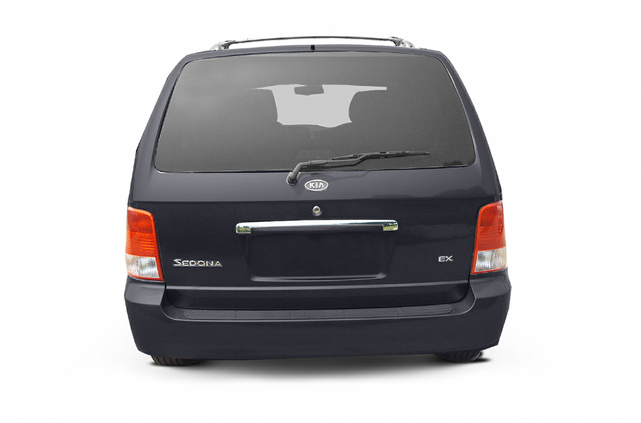
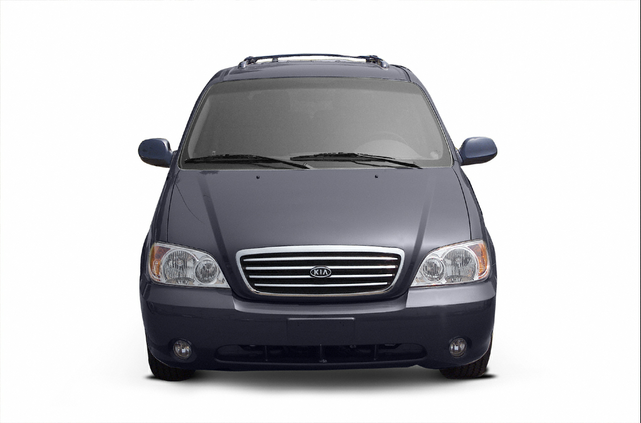
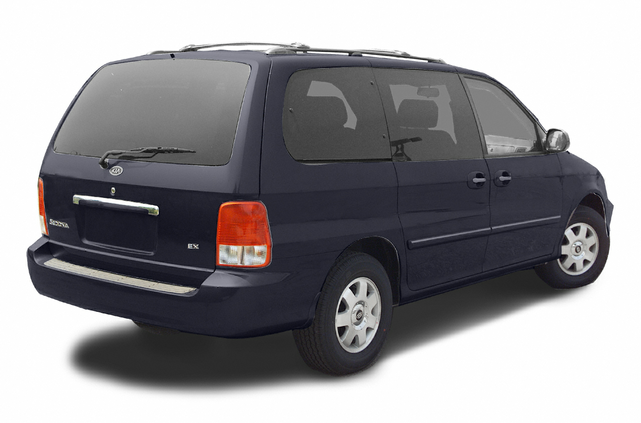
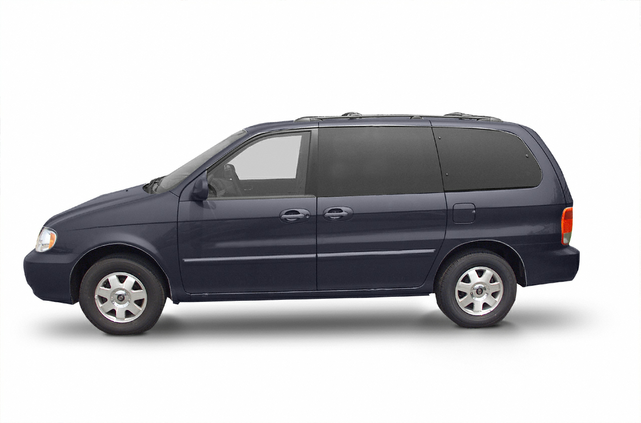
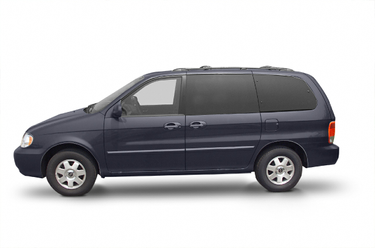
There’s nothing daring about the exterior styling, which is also to say it’s neither bizarre nor overdone. It would fit right in at any church picnic.

It’s certainly an audacious move for one of the smallest players in the U.S. market to introduce a vehicle in this class; it’s remarkable how well they did with this first effort. People buy some marques for their established quality, reflected in the absence of unscheduled trips to that torture chamber called “the dealer’s.”

With Kia, as with its new parent company Hyundai, the lure is price, with what at this point can only be characterized as a hope for longevity. Like Hyundai, Kia offers a knockout warranty that can be construed either as betokening the maker’s confidence or the marketplace’s skepticism – 10 years, 100,000 miles on the powertrain, and 5 years, 60,000 comprehensive protection. An unlimited-mileage 5-year roadside assistance plan is thrown in as a lagniappe. If that doesn’t get your attention, the sticker will. You can get in a Sedona for considerably less than 20 grand, and even that one isn’t too austere.

At a minimum, the base Sedona LX has a six-cylinder engine coupled to a five-speed automatic transmission, two sliding side doors, body-colored side moldings, privacy glass, power locks, windows and door locks, air conditioning, power mirrors, tilt wheel, cruise control and a plethora of cupholders and vanity and courtesy lights.

If you feel bad about spending so little, you can pop an extra two grand for the EX series, marked mainly by its (optional) contrasting body side moldings and some upgraded interior components. The radio is souped up and there are electrically-operated pop-out windows in the rear quarter. But mechanically, it’s identical with its more value-conscious sibling.

Antilock brakes are optional, but at least they’re available on both series. The EX can also be fitted with a power moonroof and leather seating.

The EX I was given to try out was loaded, and it still stickered at less than 24 grand, a price that falls short of what a good midsize sedan goes for these days.

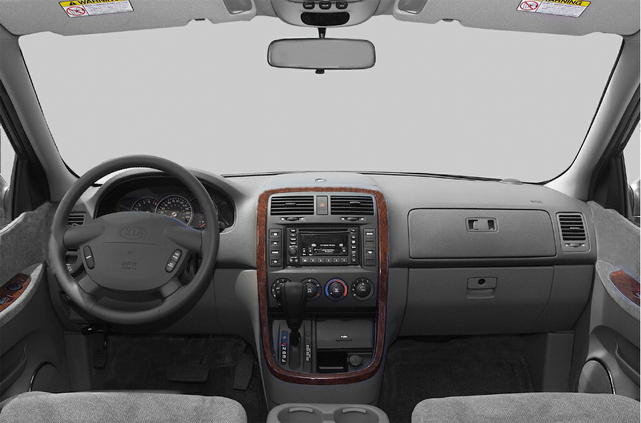
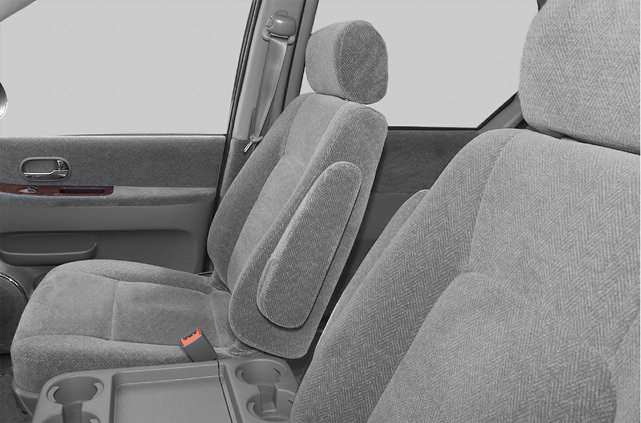
Fit and finish on my sample were quite good, and the interior materials appeared to be of good quality and were pleasant to behold and to touch. The leather even had a little of that tackroom aroma that makes it worth the price of admission. The Sedona is made in South Korea, so don’t expect to special-order one. One would imagine, given the price, that most dealers will order EXs with all the goodies, so color choice may be the only variable.

So is it as good a buy as it appears to be? Dunno, and that’s the rub. Only time will tell, although I encountered nothing that would make me doubt it.

The ride quality, unladen, was pretty good. I suspect that if it were burdened with the rated 1,186 pounds load, the shocks and springs would seem a bit overworked, but that’s okay; it’ll be spending most of its life well under gross vehicle weight, I’d imagine. That is my cue to mention something gross – the vehicle weight. Standing there with no load and half a tank of gas, a Sedona goes 4,709 pounds. That nearly 500 pounds more than a comparably equipped Dodge Grand Caravan. I suppose Kia would argue that its mass argues for the solidity of its construction, but I think the truth is they’ve not yet mastered the subtle art of saving avoirdupois without decreasing strength.

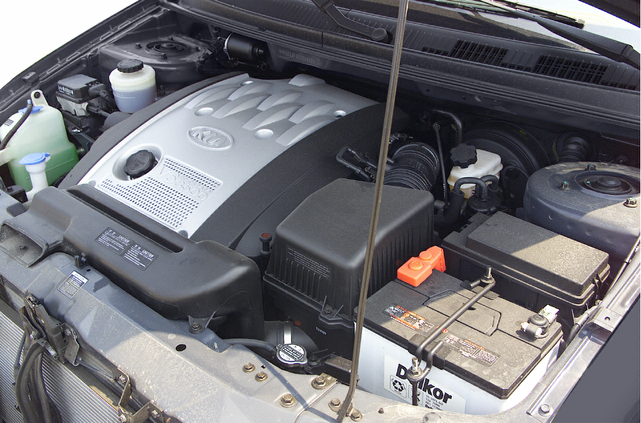
In charge of moving all that bulk is a 3.5-liter double-overhead-cam V-6 engine. It produces 195 hp at 5,500 rpm, and 218 foot-pounds of torque at 3,500. It works for 87-octane. Even with only a driver, albeit a restaurateur’s delight, the Sedona was predictably slow off the mark. It got to 60 mph in a bit over 12 seconds – school bus territory. Once under way, however, it didn’t feel all that bad. The torque was present over a fairly wide range, and with five gears abetting, the machine felt brisker than the drag-race figures imply.

The transmission was not the greatest, with sometimes harsh changes under heavy throttle and a reluctance to obey an order for a quick downshift. In moderate going it was fine.

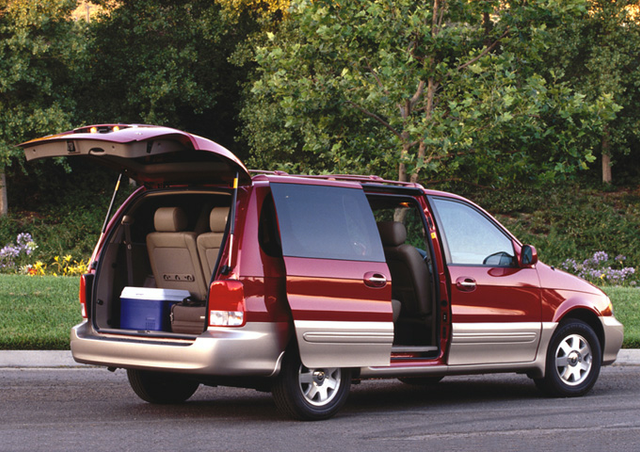
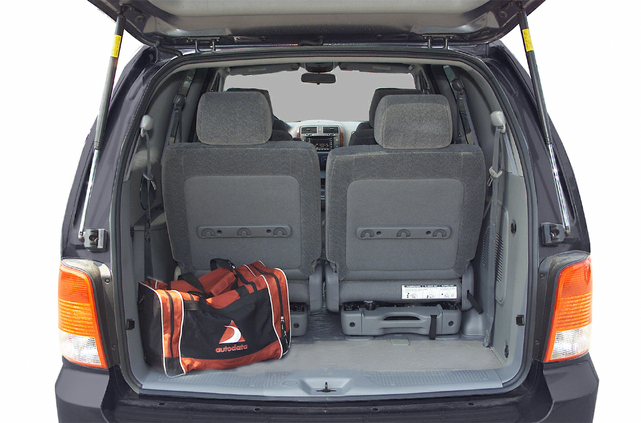
The Sedona’s official interior volume is 150 cubic feet. With all seats in place, there’s 21.8 cubic feet for cargo behind the third row, about 50 percent more space than you’d get in a midsized car’s trunk.

Kia was astute enough to maximize the utility by making the second and third rows either foldable or removable, to accommodate many permutations of people and stuff. The twin sliding doors help, too. I know moms worry about that outside door, but it has a child-safety switch which prevents it from being opened from the inside – just tell the little beggars they’re under arrest. It slid easily enough, even on a moderate grade, that I didn’t long for a power assist.

The National Highway Traffic Safety Administration gave the Sedona top marks – five stars – in every one of its four tests: front impact, side impact, front compartment, rear compartment.

Kia barely began crowing over that honor when the Insurance Institute for Highway Safety weighed in with a bucket of cold water. The IIHS tests are more severe than the government’s. They call for a 35-mph offset crash into a barrier. They decreed the Sedona “acceptable” overall, their second-highest rating. (They’re stingy with the adjectives; their top mark is “good”. They thought the test dummy was thrown about too much, suggestive of the possibility of head and neck trauma. The real bummer came when IIHS did its 5-mph bumper crash tests. When they ran the front of the Sedona into a flat barrier, both air b ags went off. (They’re not supposed to trigger unless the collision speed is 25 mph or so). Fixing them plus the bumper would cost $4,305, IIHS estimated. Air bags aside, the rear bumper seemed to be made of cardboard; it allowed $2,971 worth of damage when pounding a pole at a mere 5 mph. At that rate, it might pay to have an aftermarket radar unit added.

On the air bag issue, Kia claims it has reworked the system to keep the bags stowed unless it’s a much more serious impact. Neither head nor side-curtain bags are available.

The brakes are discs/drums. Pedal feel was rather mushy, and stopping distances were somewhat extended.

The test vehicle was $20,995 to start with. The PR staff added antilock brakes for $695, leather for $850, sunroof for $575, and two-tone paint, $195. Total suggested price, with freight, was $23,805. Payments on that one would be $483, assuming 20 percent down, 10 percent interest and 48 coupons. Edmunds.com finds a skeptical mr etplace is making dealers knock off as much as $1,800 to move the iron. Do you feel lucky?

2002 Kia Sedona review: Our expert's take
By

Tell folks your ride is a Kia, and they’re likely to arch an eyebrow.

Then a faint glimmer of recognition – ah, the pint-sized SUV – Sportage. Nope. Oh, yeah, that new Optima sedan. Wrong again, weak link.

The last thing with which they’re likely to associate the name is a minivan, for this is the first minivan to originate in South Korea, Kia’s home, and was just introduced for the 2002 model year. It’s not mini in the sense of tiny, either, but rather in the accepted sense of garageable, unlike those things that make runs to the airport.

In size, the Sedona lies between the standard-wheelbase Dodge Caravan and the extended wheel-base version of that archetypal soccer-mom mount.

To which, it can accommodate 7 people, assuming the median age isn’t too high, stretching 194 inches overall. The axles are 114 inches apart.

It stands 5 feet, 9 inches high, so it’s neither cute nor overwhelming, and offers a driving position that is the No. 1 thing many people love about SUVs and minivans: raised above the passenger-car riff-raff.

There’s nothing daring about the exterior styling, which is also to say it’s neither bizarre nor overdone. It would fit right in at any church picnic.

It’s certainly an audacious move for one of the smallest players in the U.S. market to introduce a vehicle in this class; it’s remarkable how well they did with this first effort. People buy some marques for their established quality, reflected in the absence of unscheduled trips to that torture chamber called “the dealer’s.”

With Kia, as with its new parent company Hyundai, the lure is price, with what at this point can only be characterized as a hope for longevity. Like Hyundai, Kia offers a knockout warranty that can be construed either as betokening the maker’s confidence or the marketplace’s skepticism – 10 years, 100,000 miles on the powertrain, and 5 years, 60,000 comprehensive protection. An unlimited-mileage 5-year roadside assistance plan is thrown in as a lagniappe. If that doesn’t get your attention, the sticker will. You can get in a Sedona for considerably less than 20 grand, and even that one isn’t too austere.

At a minimum, the base Sedona LX has a six-cylinder engine coupled to a five-speed automatic transmission, two sliding side doors, body-colored side moldings, privacy glass, power locks, windows and door locks, air conditioning, power mirrors, tilt wheel, cruise control and a plethora of cupholders and vanity and courtesy lights.

If you feel bad about spending so little, you can pop an extra two grand for the EX series, marked mainly by its (optional) contrasting body side moldings and some upgraded interior components. The radio is souped up and there are electrically-operated pop-out windows in the rear quarter. But mechanically, it’s identical with its more value-conscious sibling.

Antilock brakes are optional, but at least they’re available on both series. The EX can also be fitted with a power moonroof and leather seating.

The EX I was given to try out was loaded, and it still stickered at less than 24 grand, a price that falls short of what a good midsize sedan goes for these days.

Fit and finish on my sample were quite good, and the interior materials appeared to be of good quality and were pleasant to behold and to touch. The leather even had a little of that tackroom aroma that makes it worth the price of admission. The Sedona is made in South Korea, so don’t expect to special-order one. One would imagine, given the price, that most dealers will order EXs with all the goodies, so color choice may be the only variable.

So is it as good a buy as it appears to be? Dunno, and that’s the rub. Only time will tell, although I encountered nothing that would make me doubt it.

The ride quality, unladen, was pretty good. I suspect that if it were burdened with the rated 1,186 pounds load, the shocks and springs would seem a bit overworked, but that’s okay; it’ll be spending most of its life well under gross vehicle weight, I’d imagine. That is my cue to mention something gross – the vehicle weight. Standing there with no load and half a tank of gas, a Sedona goes 4,709 pounds. That nearly 500 pounds more than a comparably equipped Dodge Grand Caravan. I suppose Kia would argue that its mass argues for the solidity of its construction, but I think the truth is they’ve not yet mastered the subtle art of saving avoirdupois without decreasing strength.

In charge of moving all that bulk is a 3.5-liter double-overhead-cam V-6 engine. It produces 195 hp at 5,500 rpm, and 218 foot-pounds of torque at 3,500. It works for 87-octane. Even with only a driver, albeit a restaurateur’s delight, the Sedona was predictably slow off the mark. It got to 60 mph in a bit over 12 seconds – school bus territory. Once under way, however, it didn’t feel all that bad. The torque was present over a fairly wide range, and with five gears abetting, the machine felt brisker than the drag-race figures imply.

The transmission was not the greatest, with sometimes harsh changes under heavy throttle and a reluctance to obey an order for a quick downshift. In moderate going it was fine.

The Sedona’s official interior volume is 150 cubic feet. With all seats in place, there’s 21.8 cubic feet for cargo behind the third row, about 50 percent more space than you’d get in a midsized car’s trunk.

Kia was astute enough to maximize the utility by making the second and third rows either foldable or removable, to accommodate many permutations of people and stuff. The twin sliding doors help, too. I know moms worry about that outside door, but it has a child-safety switch which prevents it from being opened from the inside – just tell the little beggars they’re under arrest. It slid easily enough, even on a moderate grade, that I didn’t long for a power assist.

The National Highway Traffic Safety Administration gave the Sedona top marks – five stars – in every one of its four tests: front impact, side impact, front compartment, rear compartment.

Kia barely began crowing over that honor when the Insurance Institute for Highway Safety weighed in with a bucket of cold water. The IIHS tests are more severe than the government’s. They call for a 35-mph offset crash into a barrier. They decreed the Sedona “acceptable” overall, their second-highest rating. (They’re stingy with the adjectives; their top mark is “good”. They thought the test dummy was thrown about too much, suggestive of the possibility of head and neck trauma. The real bummer came when IIHS did its 5-mph bumper crash tests. When they ran the front of the Sedona into a flat barrier, both air b ags went off. (They’re not supposed to trigger unless the collision speed is 25 mph or so). Fixing them plus the bumper would cost $4,305, IIHS estimated. Air bags aside, the rear bumper seemed to be made of cardboard; it allowed $2,971 worth of damage when pounding a pole at a mere 5 mph. At that rate, it might pay to have an aftermarket radar unit added.

On the air bag issue, Kia claims it has reworked the system to keep the bags stowed unless it’s a much more serious impact. Neither head nor side-curtain bags are available.

The brakes are discs/drums. Pedal feel was rather mushy, and stopping distances were somewhat extended.

The test vehicle was $20,995 to start with. The PR staff added antilock brakes for $695, leather for $850, sunroof for $575, and two-tone paint, $195. Total suggested price, with freight, was $23,805. Payments on that one would be $483, assuming 20 percent down, 10 percent interest and 48 coupons. Edmunds.com finds a skeptical mr etplace is making dealers knock off as much as $1,800 to move the iron. Do you feel lucky?

Safety review

Based on the 2002 Kia Sedona base trim
NHTSA crash test and rollover ratings, scored out of 5.
Frontal driver
5/5
Frontal passenger
5/5
Nhtsa rollover rating
4/5
Side driver
5/5
Side rear passenger
5/5

Factory warranties

New car program benefits

Basic
5 years / 60,000 miles
Corrosion
5 years / 100,000 miles
Powertrain
10 years / 100,000 miles
Roadside Assistance
5 years

Certified Pre-Owned program benefits

Dealer certification
135 Point Inspection

Compare similar vehicles

Select cars to compare for more detailed info.
  • 2002
    Kia Sedona
    Starts at
    $18,995
    15 City / 20 Hwy
    MPG
    7
    Seat capacity
    -
    Warranty
    Gas V6
    Engine
    Front-wheel drive
    Drivetrain
    Compare
  • 2001
    Chrysler PT Cruiser
    Starts at
    $15,935
    20 City / 25 Hwy
    MPG
    5
    Seat capacity
    -
    Warranty
    Gas I-4
    Engine
    Front-wheel drive
    Drivetrain
    Compare
  • 2012
    Kia Optima Hybrid
    Starts at
    $25,800
    34 City / 39 Hwy
    MPG
    5
    Seat capacity
    120 month/100,000 miles
    Warranty
    Gas/Electric I4
    Engine
    Front-wheel drive
    Drivetrain
    Compare
  • 2006
    Kia Sedona
    Starts at
    $23,195
    18 City / 25 Hwy
    MPG
    7
    Seat capacity
    -
    Warranty
    Gas V6
    Engine
    Front-wheel drive
    Drivetrain
    Compare
  • 1997
    Kia Sportage
    Starts at
    $14,495
    19 City / 22 Hwy
    MPG
    5
    Seat capacity
    -
    Warranty
    Gas I4
    Engine
    Rear-wheel drive
    Drivetrain
    Compare
  • 2014
    Nissan Quest
    Starts at
    $26,220
    19 City / 25 Hwy
    MPG
    7
    Seat capacity
    -
    Warranty
    Regular Unleaded V-6
    Engine
    Front-wheel drive
    Drivetrain
    Compare
  • 2010
    Chrysler Sebring
    Starts at
    $20,120
    20 City / 29 Hwy
    MPG
    4
    Seat capacity
    -
    Warranty
    Gas V6
    Engine
    Front-wheel drive
    Drivetrain
    Compare
  • 2003
    Chrysler Voyager
    Starts at
    $20,960
    21 City / 27 Hwy
    MPG
    2
    Seat capacity
    -
    Warranty
    Gas I4
    Engine
    Front-wheel drive
    Drivetrain
    Compare
  • Compare more options
    Use our comparison tool to add any vehicle of your choice and see a full list of specifications and features side-by-side.
    Try it now

Consumer reviews

No reviews yet

This car doesn’t have a consumer review yet.
Write the first review

Latest news from Cars.com

See all news

Kia dealers near you

FAQ

What trim levels are available for the 2002 Kia Sedona?

The 2002 Kia Sedona is available in 2 trim levels:

  • EX (1 style)
  • LX (1 style)

What is the MPG of the 2002 Kia Sedona?

The 2002 Kia Sedona offers up to 15 MPG in city driving and 20 MPG on the highway. These figures are based on EPA mileage ratings and are for comparison purposes only. The actual mileage will vary depending on vehicle options, trim level, driving conditions, driving habits, vehicle maintenance, and other factors.

What are some similar vehicles and competitors of the 2002 Kia Sedona?

The 2002 Kia Sedona compares to and/or competes against the following vehicles:

Kia Sedona history

Your list was successfully saved.


Save list Compare
[{"cat":"van_mini","stock_type":"used","bodystyle":"Minivan","page_type":"research/make-model-year","oem_page":false,"search_fuel_types":["Gasoline Fuel"]}]