



2026 2025 2024 2023 2022 2021 2020 2019 2005 2004 2003 2002 2001 2000 1999 1998 1997 1996 1995 1994 1993 1992
Chevrolet Blazer

Shop options
$20,211
Avg. listing price
Shop the 2020 Chevrolet Blazer
Browse cars & save your favorites
Dealers near you
Find & contact a dealership near you
Listings near 43287
Change location See all listings

Available trims

See the differences side-by-side to compare trims.
  • FWD 4dr L
    MPG
    21 City / 27 Hwy
    Seat capacity
    5
    Engine
    Gas I4
    Drivetrain
    Front Wheel Drive
    Shop this trim See all specs
  • FWD 4dr LT w/1LT
    Avg. price
    $18,003
    MPG
    21 City / 27 Hwy
    Seat capacity
    5
    Engine
    Gas I4
    Drivetrain
    Front Wheel Drive
    Shop this trim See all specs
  • FWD 4dr LT w/2LT
    Avg. price
    $18,565
    MPG
    21 City / 28 Hwy
    Seat capacity
    5
    Engine
    Gas I4
    Drivetrain
    Front Wheel Drive
    Shop this trim See all specs
  • AWD 4dr LT w/2LT
    Avg. price
    $18,565
    MPG
    21 City / 27 Hwy
    Seat capacity
    5
    Engine
    Gas I4
    Drivetrain
    All Wheel Drive
    Shop this trim See all specs
  • FWD 4dr LT w/3LT
    Avg. price
    $19,220
    MPG
    21 City / 28 Hwy
    Seat capacity
    5
    Engine
    Gas I4
    Drivetrain
    Front Wheel Drive
    Shop this trim See all specs
  • AWD 4dr LT w/3LT
    Avg. price
    $19,220
    MPG
    21 City / 27 Hwy
    Seat capacity
    5
    Engine
    Gas I4
    Drivetrain
    All Wheel Drive
    Shop this trim See all specs
  • FWD 4dr RS
    Avg. price
    $22,469
    MPG
    19 City / 26 Hwy
    Seat capacity
    5
    Engine
    Gas V6
    Drivetrain
    Front Wheel Drive
    Shop this trim See all specs
  • FWD 4dr Premier
    Avg. price
    $22,189
    MPG
    19 City / 26 Hwy
    Seat capacity
    5
    Engine
    Gas V6
    Drivetrain
    Front Wheel Drive
    Shop this trim See all specs
  • AWD 4dr RS
    Avg. price
    $22,469
    MPG
    18 City / 25 Hwy
    Seat capacity
    5
    Engine
    Gas V6
    Drivetrain
    All Wheel Drive
    Shop this trim See all specs
  • AWD 4dr Premier
    Avg. price
    $22,189
    MPG
    18 City / 25 Hwy
    Seat capacity
    5
    Engine
    Gas V6
    Drivetrain
    All Wheel Drive
    Shop this trim See all specs

The good & the bad

This vehicle doesn't have any good or bad insights yet.

Use our comparison tool to look at this model side-by-side with other vehicles or view the full specifications list .

Start your comparison

Expert 2020 Chevrolet Blazer review

Our expert's take
Full article

The verdict: Chevrolet has built the SUV-obsessed 21st century’s answer to the traditional family sports sedan.

Versus the competition: Competitors generally feature a lot more standard safety equipment and all-wheel drive at lower prices, but they don’t look this good. Though if sporting ability is really what you’re going for — not just sporty looks — it’s hard to top the Ford Edge ST’s twin-turbocharged muscle.

When Chevrolet first announced it would bring back the “Blazer” name and slap it on an SUV, four-wheel-drive enthusiasts around the country were thrilled: Was Chevy going to get back into the true off-road SUV game thanks to the perennial popularity of the Jeep Wrangler and the mad interest in the still-unseen, upcoming 2020 Ford Bronco? Turns out, the answer was “no.” When the 2019 Chevrolet Blazer was unveiled at a private event in the summer of 2018, we saw not a rugged off-roader at all, but rather a stylish, sporty, two-row, five-seat crossover SUV meant to challenge the Ford Edge, Hyundai Santa Fe and Nissan Murano.

Admittedly, the move makes sense. Mid-size SUVs like the new Blazer are the second-hottest-growing segment in the market (behind compact SUVs like Chevrolet’s own Equinox), so having an entry here — bringing the crossover count in Chevy showrooms up to four (Blazer, Equinox, Trax and Traverse) — couldn’t hurt. But does the market need another crossover-style SUV? Is the Blazer good enough to carve off buyers from its popular competitors?

The Sports Sedan Crossover

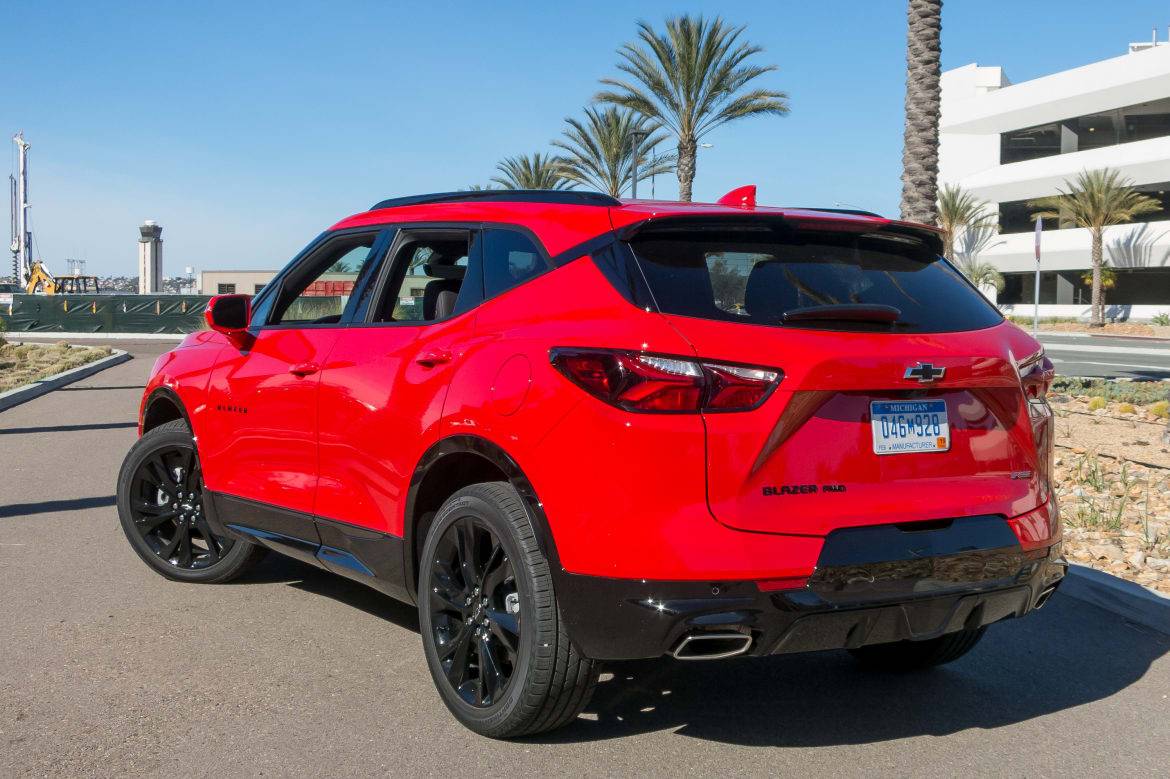
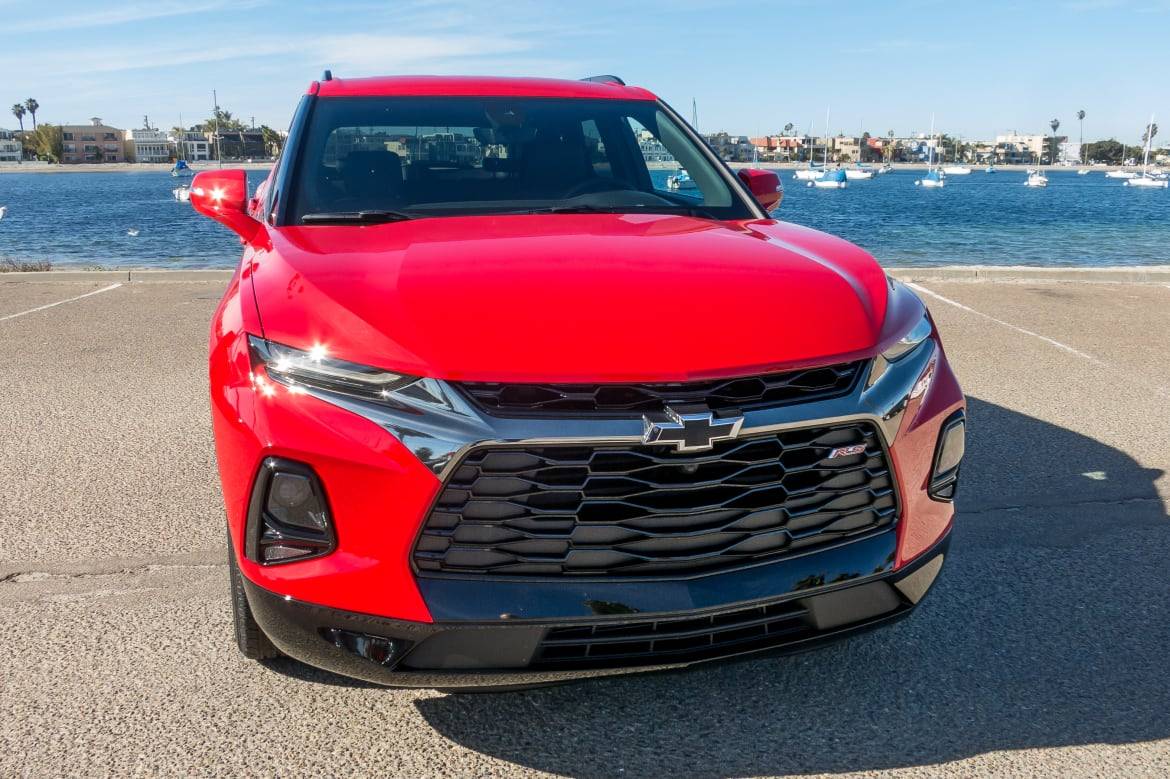
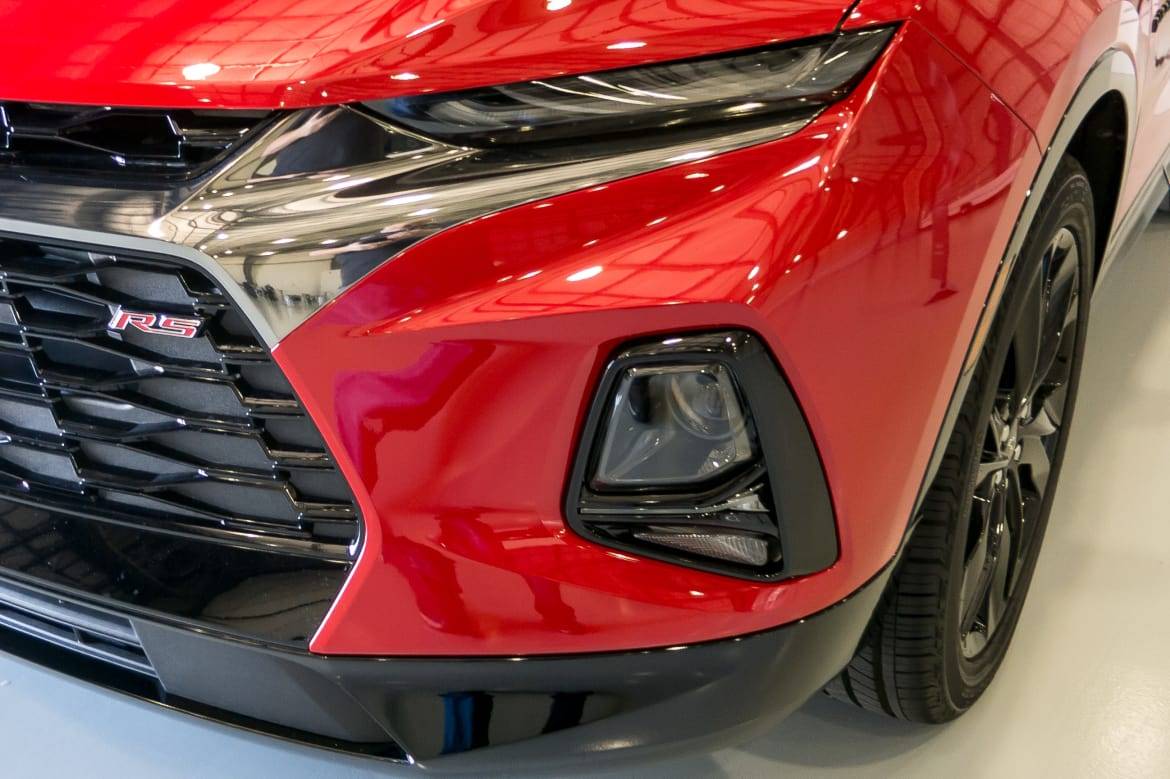
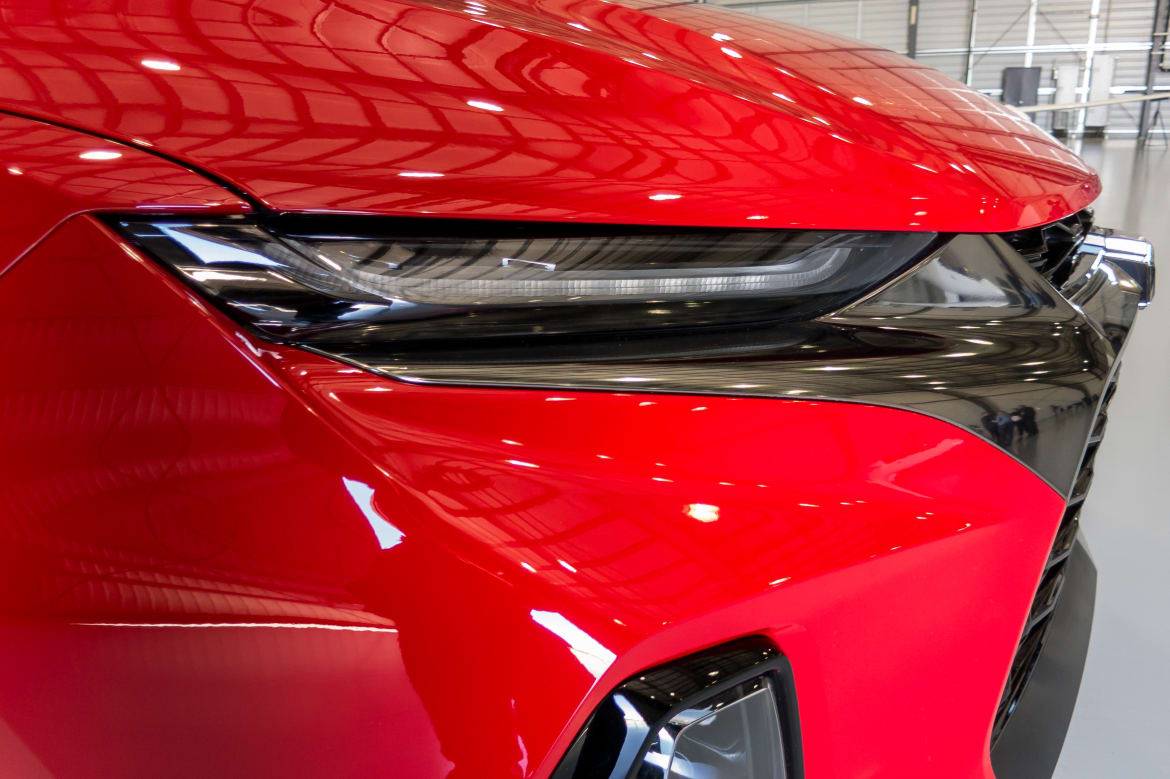
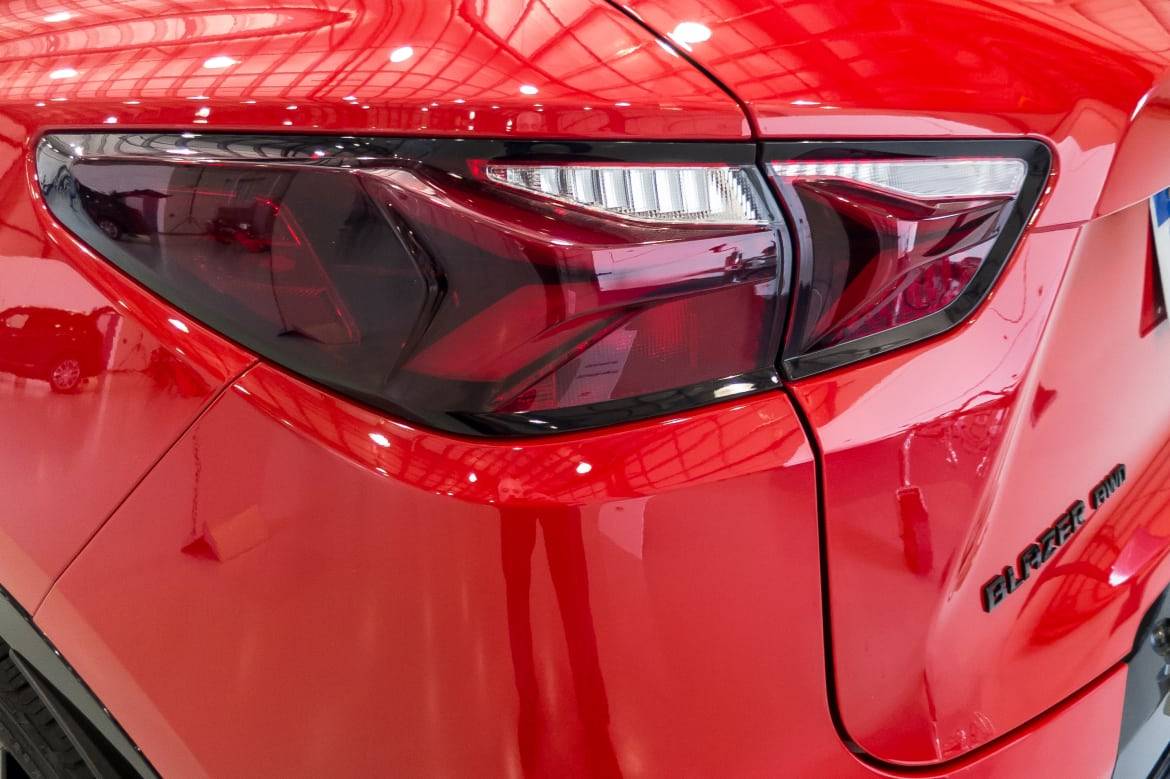
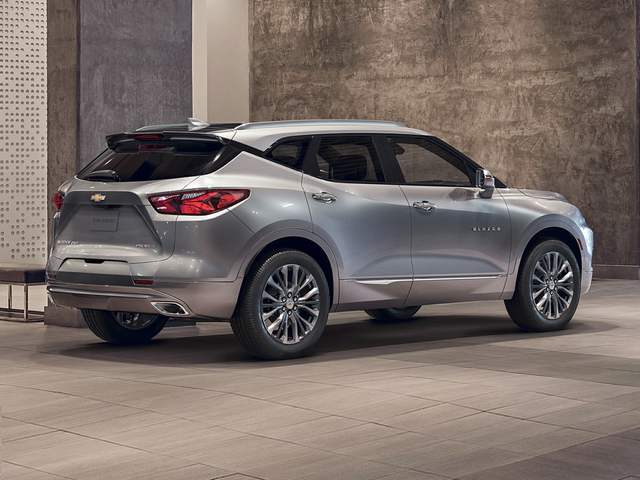
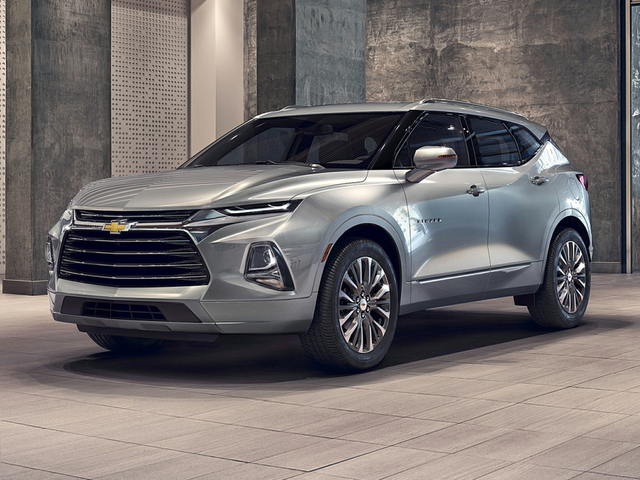
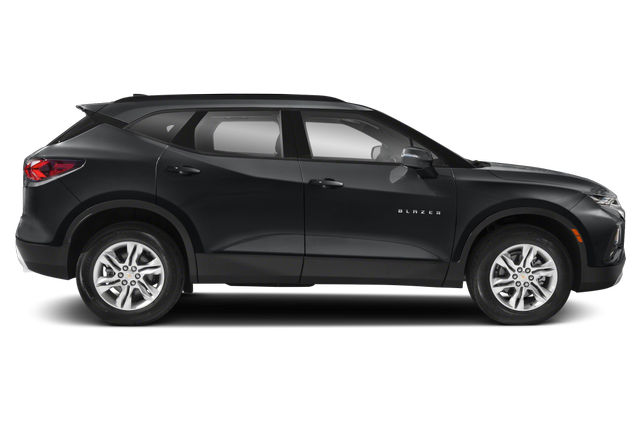
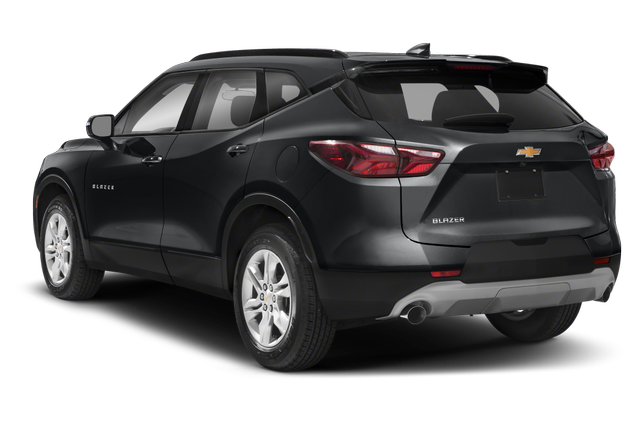
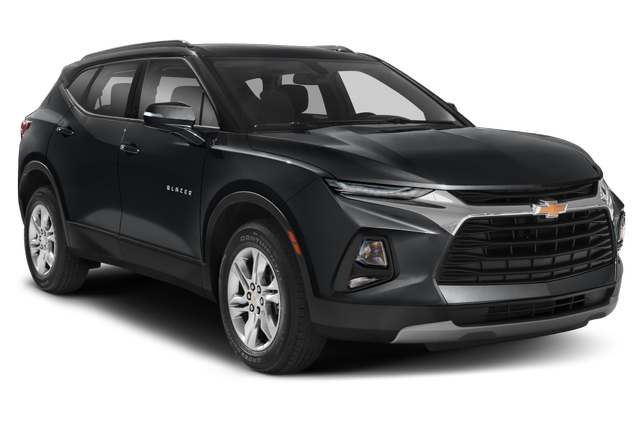
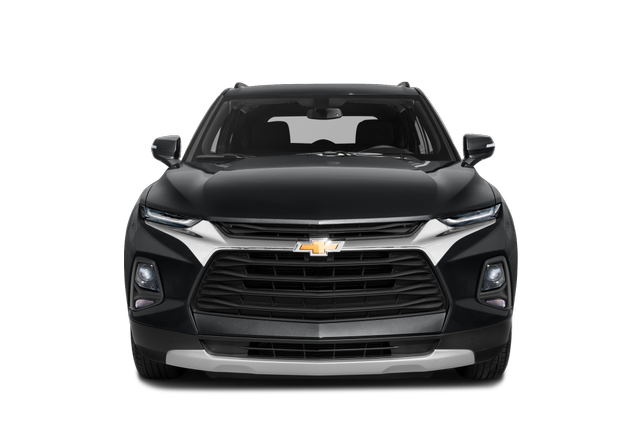
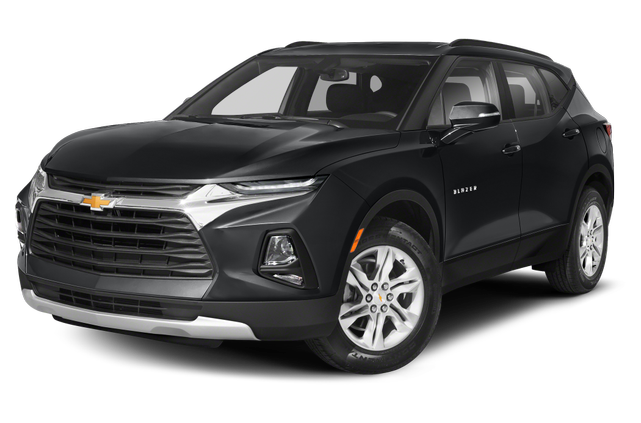
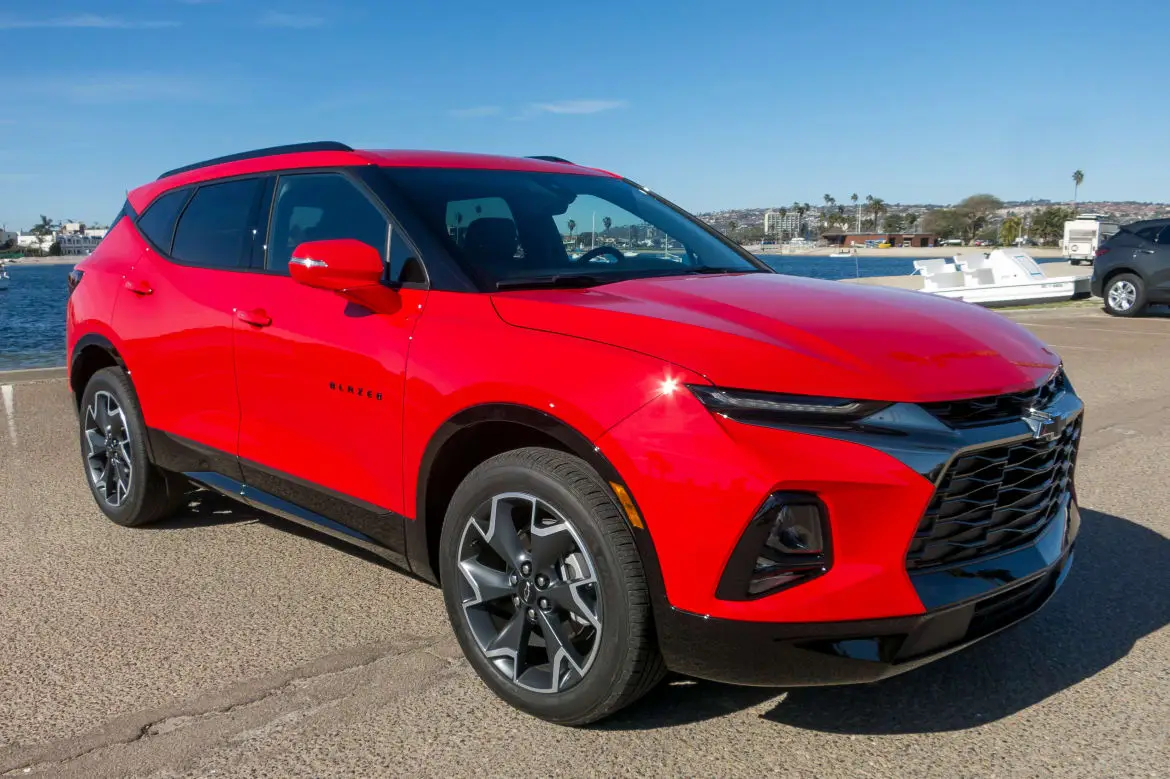
There’s no denying the Blazer makes a statement. There’s a presence to its styling that sets it apart in a field of boring two-box designs. The Chevrolet Camaro influences are obvious, from the swoopy front end to the prominent fenders, then reaching back to the sleek, angular taillights. An RS trim in bright red is without a doubt the sportiest looking crossover SUV in the class. While other competitors go for the rugged off-roader look, the Blazer makes no apologies about being an on-road warrior. And this makes sense: Crossovers are replacing sedans as the family vehicle of choice in America, so what should you get if you typically enjoy a sports sedan? Asks Chevy: How about a sports crossover?

More Substantial Than Expected

The biggest surprise of the Blazer is how much more substantial it feels than the Equinox. It has a more sophisticated chassis, using a McPherson strut front suspension and a five-link rear; it sits on the same one as the GMC Acadia, Cadillac XT5 and XT6. It’s wider than the Equinox and almost as wide as the much larger Traverse, which lends the Blazer a sense of stability and heft over all types of road surfaces. Chevy engineers did some amazing work isolating the Blazer from road imperfections, even with the optional 21-inch wheels. The steering has weight to it and body control is excellent, with very little wallowing in corners or undue motions that can translate into an unpleasant ride experience. This surprisingly substantial-feeling SUV’s road manners are easily a match for the Ford Edge or Nissan Murano.

Two powertrains are offered. The standard setup is a 2.5-liter four-cylinder Ecotec engine making 193 horsepower and 188 pounds-feet of torque, mated to a nine-speed automatic transmission that drives the front wheels. (All-wheel drive is not an option with the four-cylinder engine.) That four-cylinder is a perfectly fine powertrain choice; its lighter weight and lack of AWD equipment create a sprightly nimble feel. Acceleration is brisk even when getting on the highway, though it might be another story when loaded up with people and stuff. At roughly 3,800 pounds, the four-cylinder Blazer has a roughly 400-pound weight advantage over the AWD V-6 model, according to Chevrolet engineers, and that manifests in its handling and ride.

The other powertrain is GM’s ubiquitous 3.6-liter “Generation II High Feature” V-6, making 308 hp and 270 pounds-feet of torque, also mated to the nine-speed automatic. You can have it in regular, Premier or RS flavors. Chevrolet is taking a page out of Cadillac’s playbook, offering the top versions of the Blazer in two themes: luxury if you get the Premier trim, sport if you opt for the RS. All-wheel drive is optional on the V-6 Blazer, and a more sophisticated twin-clutch AWD system can be had on the Premier and RS.

The V-6 model is decidedly heavier, but it doesn’t feel poky or slow, just more substantial and solid. Acceleration is quick, but it doesn’t have the snappy torque curve of some rivals’ turbocharged four-cylinder engines. What it does enable is a 4,500-pound maximum towing capacity when properly equipped. The Premier trim feels just as solid and substantial as the base four-cylinder Blazer, with the added benefit of some extra grunt when you plant your right foot, accompanied by a muted growl.

Fuel economy takes a bit of a hit when you upgrade the engine. The Blazer is EPA-rated 22/27/24 mpg city/highway/combined for the four-cylinder model, dropping to 20/26/22 mpg for the FWD V-6 and 18/25/21 mpg for the AWD V-6. I put more than 500 miles on a Blazer RS V-6 and averaged 21.5 mpg overall — not a great number for a crossover with a nine-speed automatic and non-defeatable engine stop-start. The Blazer’s rating matches the V-6 Jeep Grand Cherokee 4×4, but it isn’t quite as good as the AWD Nissan Murano V-6 with its continuously variable automatic transmission, which rates 20/28/23 mpg, or the significantly more powerful Ford Edge ST’s 2.7-liter twin-turbo V-6, which comes in at 19/26/21 mpg.

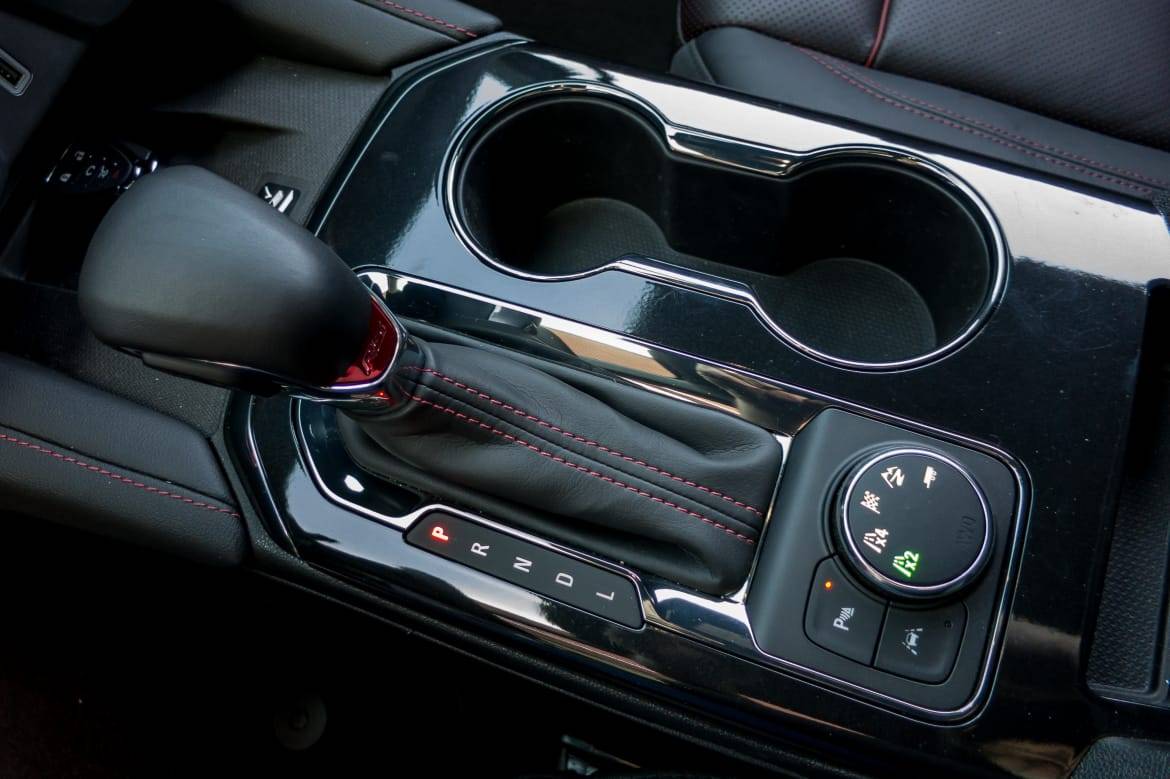
There are a few drive modes to select from, including one that disconnects the AWD system for slightly better fuel economy. There’s a Sport mode that changes a few parameters, including AWD torque distribution but surprisingly leaving out throttle response and shift patterns for the transmission. Off-Road mode adjusts throttle response, but given the lack of significant ground clearance or underbody protection, I wouldn’t recommend taking a Blazer anywhere but a dirt road. Finally, a Tow/Haul mode holds on to lower gears longer for better response while hauling a trailer.

Sporting Pretenses

While the Premier version amps up the luxury quotient, the RS is the more dramatic of the Blazers. It adds more than just an appearance package, as we’ve seen on previous Chevrolets; it’s more like the Traverse’s RS trim level in terms of the visual and parts changes. While it doesn’t get a unique engine, like the Traverse RS has, it does receive some significant suspension and steering changes to alter its demeanor: The front struts get 40 percent more compression control, while the rear shocks improve by 15 percent. The steering ratio is quicker —  a 15-to-1 ratio instead of other Blazers’ 16-to-1 ratio. The twin-clutch AWD allows torque to be transferred side to side in addition to front to back, and 21-inch wheels are optional.

All this together gives the RS a more sporting character despite it not having more power to play with. Body control remains impressive, but the quicker-ratio steering is barely noticeable. The changes don’t make the RS all that sporty, and it certainly can’t hold a candle to the performance delivered by a Ford Edge ST, which has more than 100 pounds-feet of torque superiority from its twin-turbocharged engine. This makes the RS the choice to make if you just want the styling flash it offers; the almost European-feeling ride and handling combination is mostly a bonus. Otherwise, the Premier is a perfectly acceptable (if more expensive) option.

Camaro-Influenced Cockpit

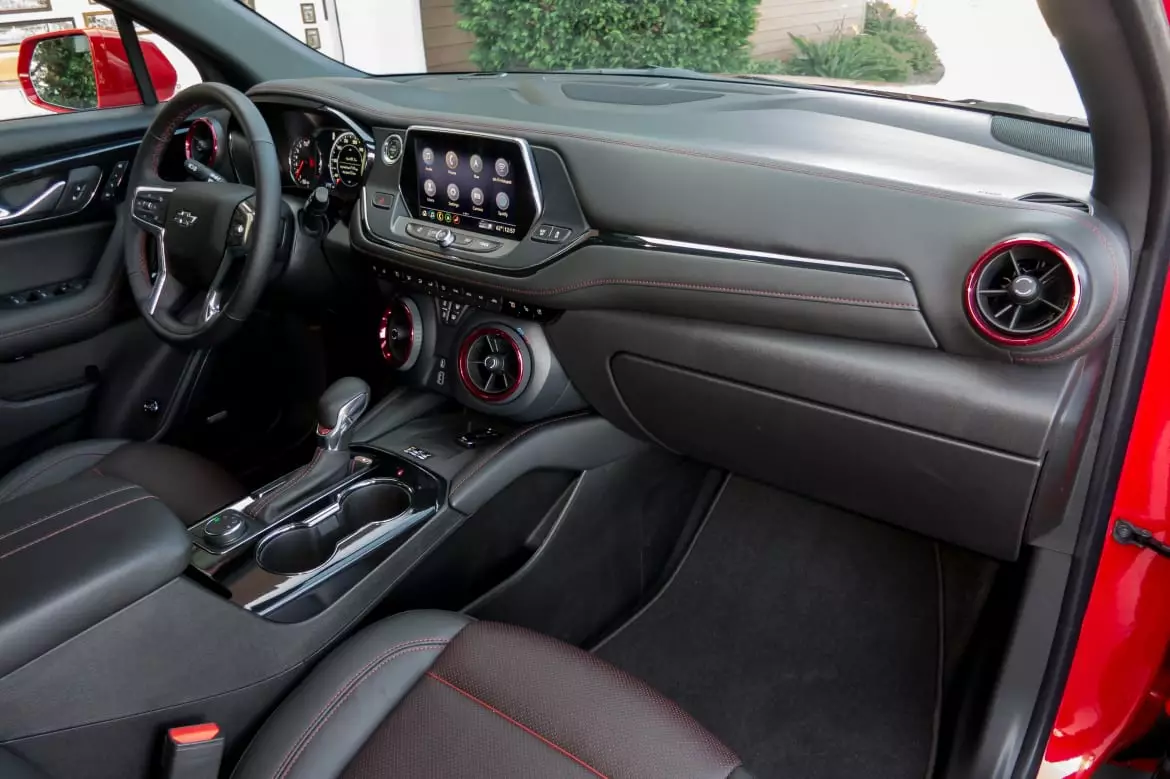
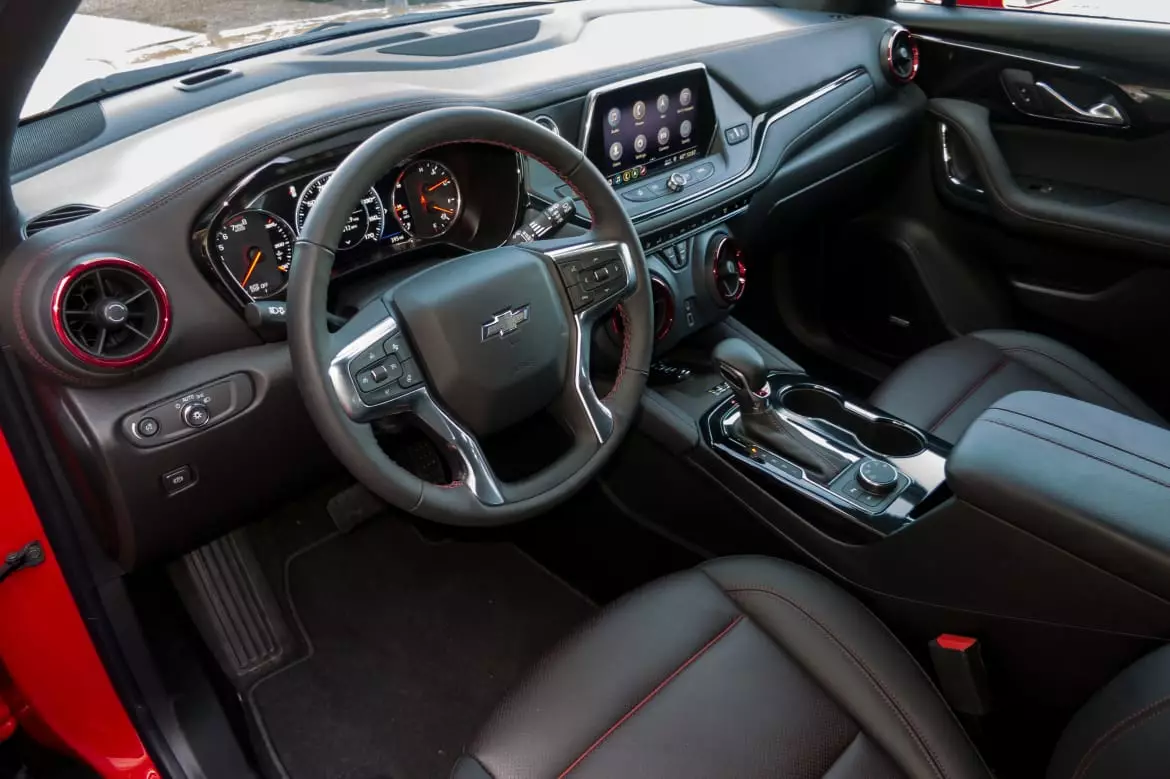
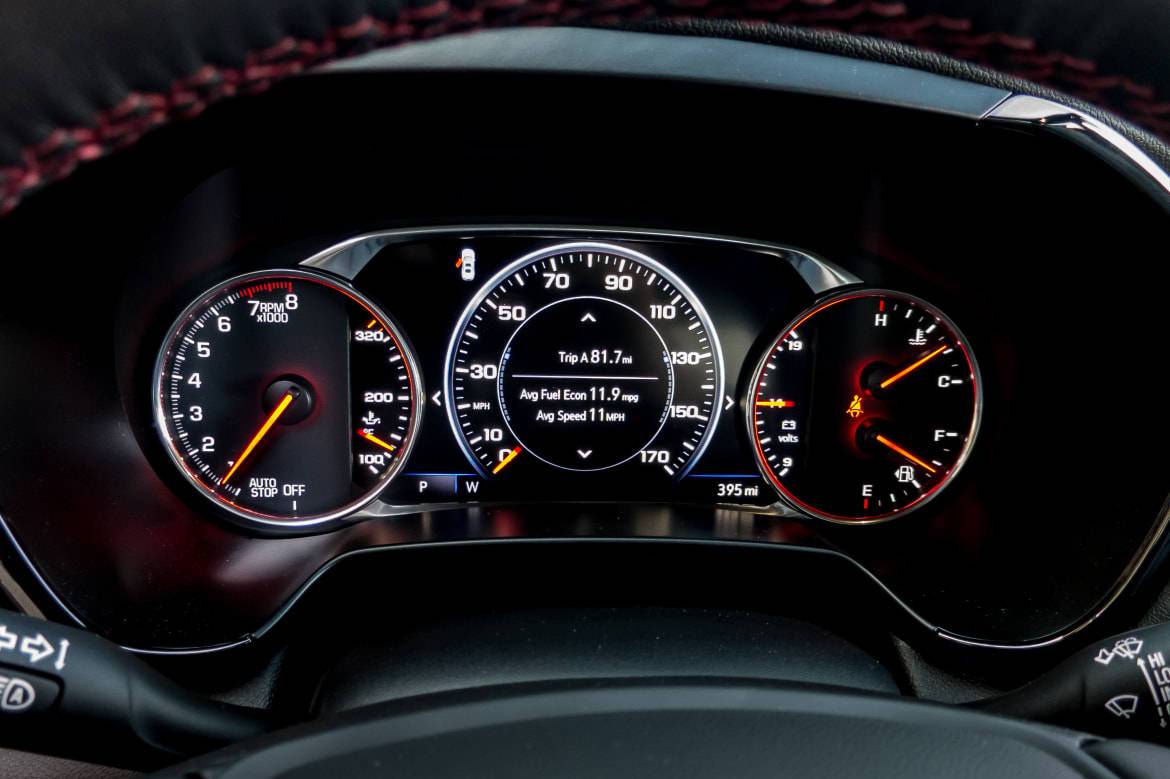
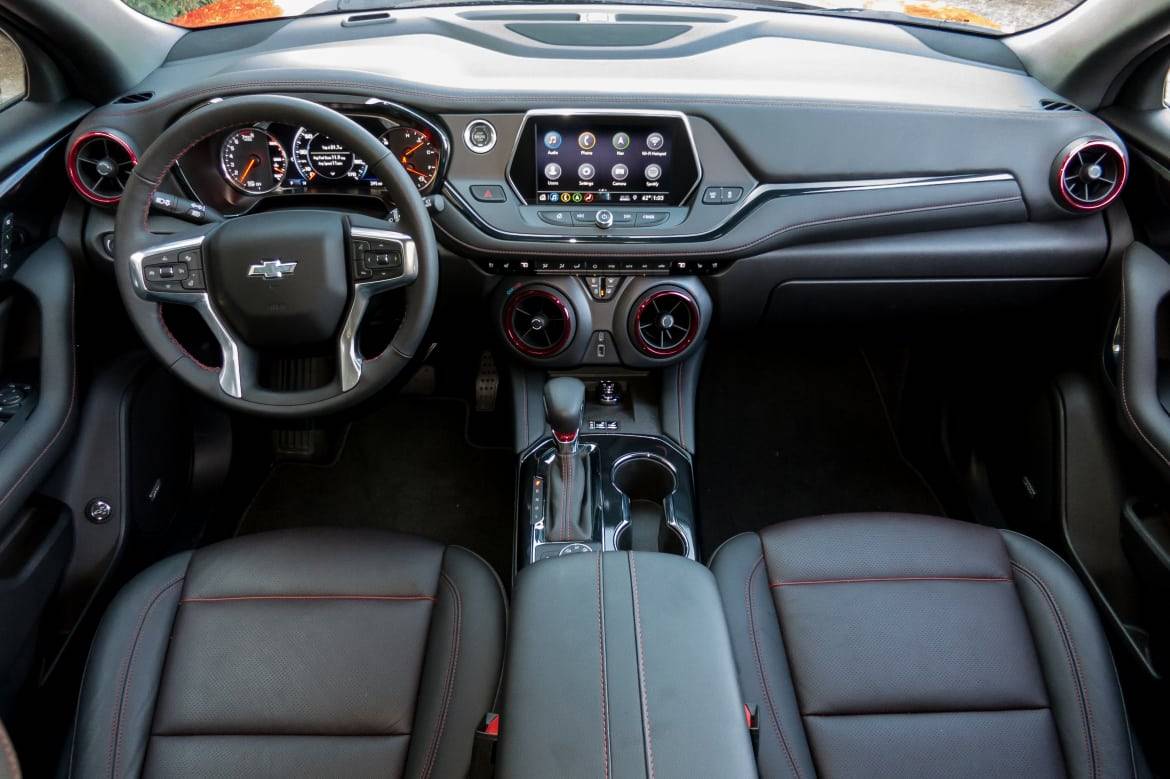
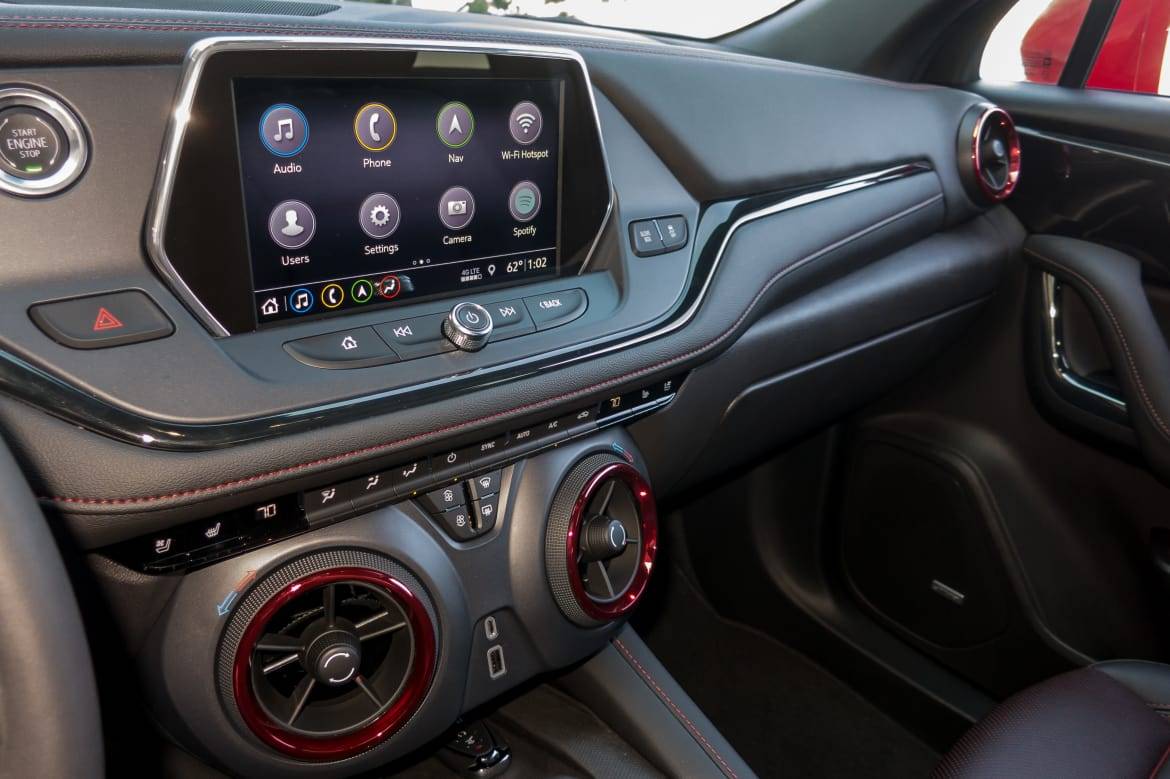
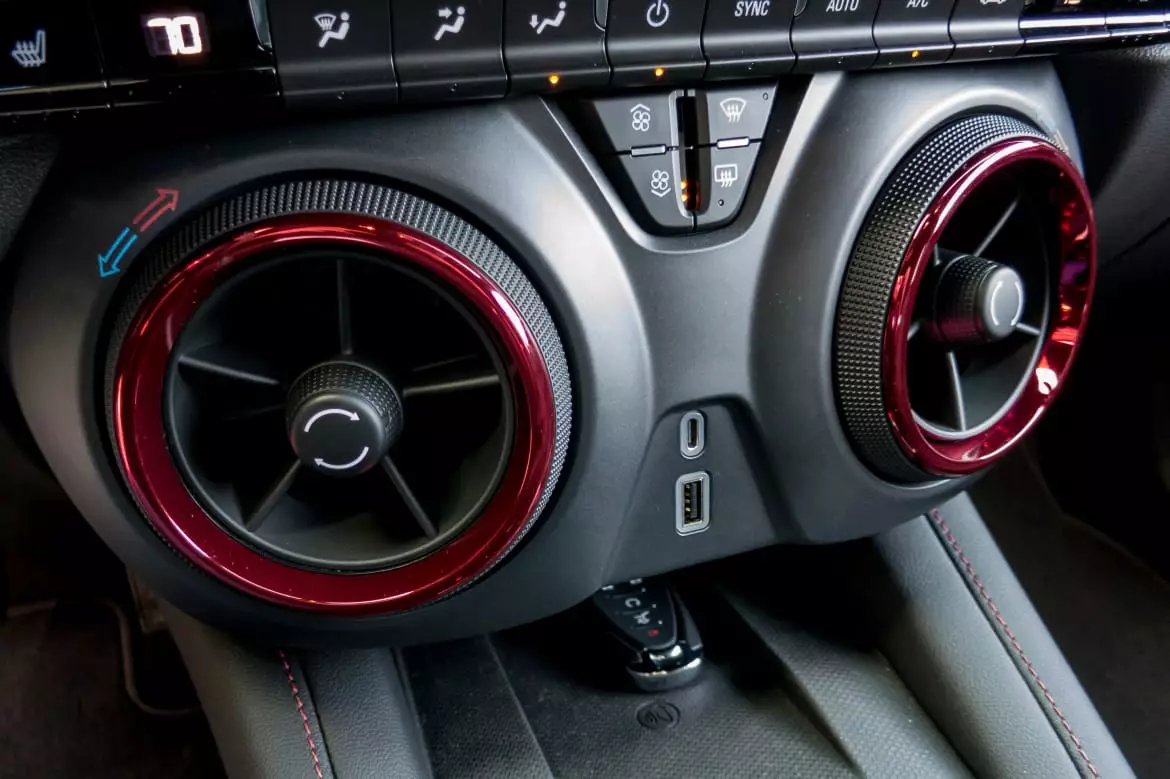
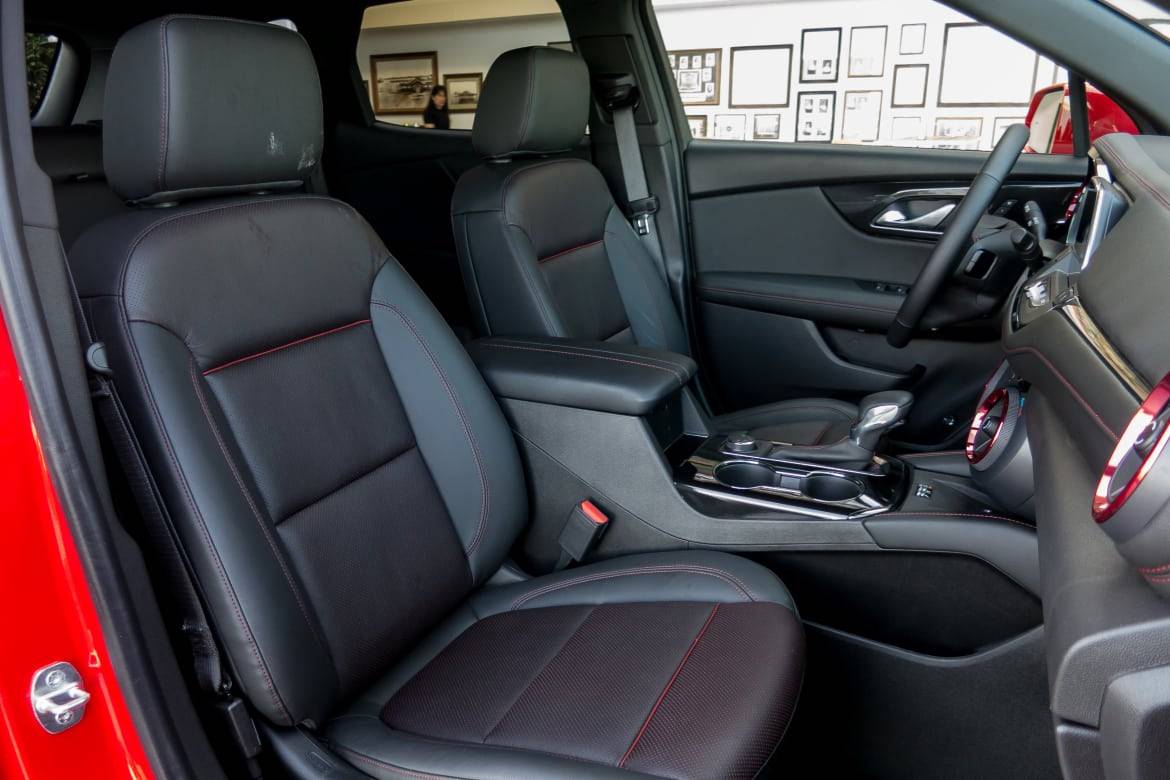
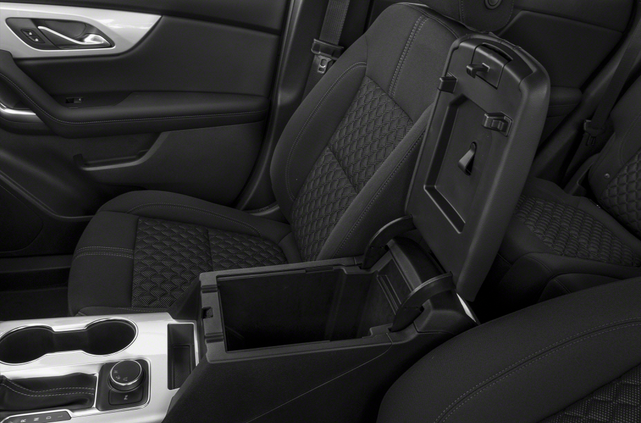
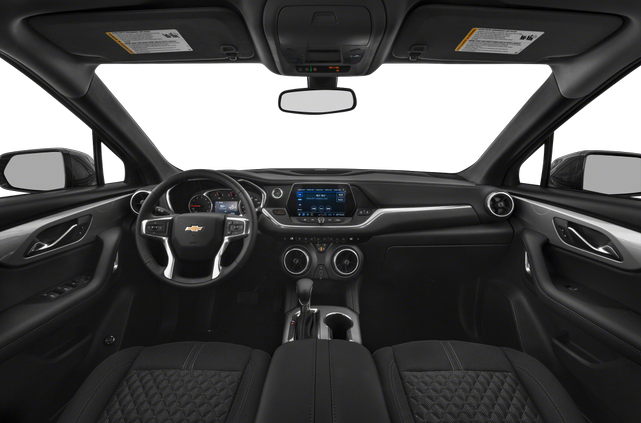
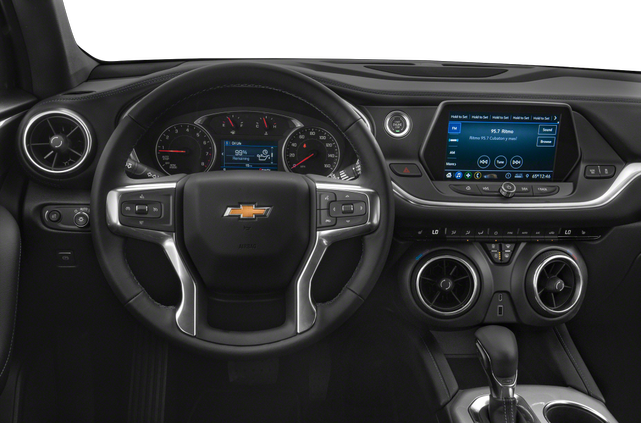
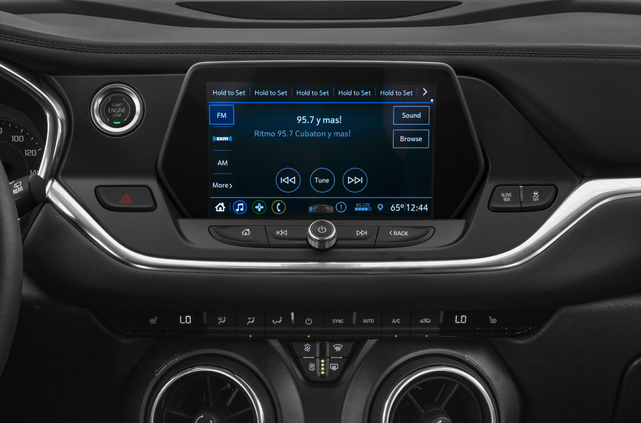
Regardless of which Blazer trim level you get, the interior shows direct influence from the Camaro sports coupe — and it’s a successful integration. The dash design is appealingly sporty, and anyone fond of the Camaro’s layout will find a lot to like in here, too, from the placement of the multimedia screen to the round vent rings that also control temperature settings. The buttons are artfully located and everything is easy to use, and we applaud Chevrolet for not removing the height-adjustable shoulder belts in the Blazer, as it’s done with just about every other new Chevy that’s come down the pike recently.

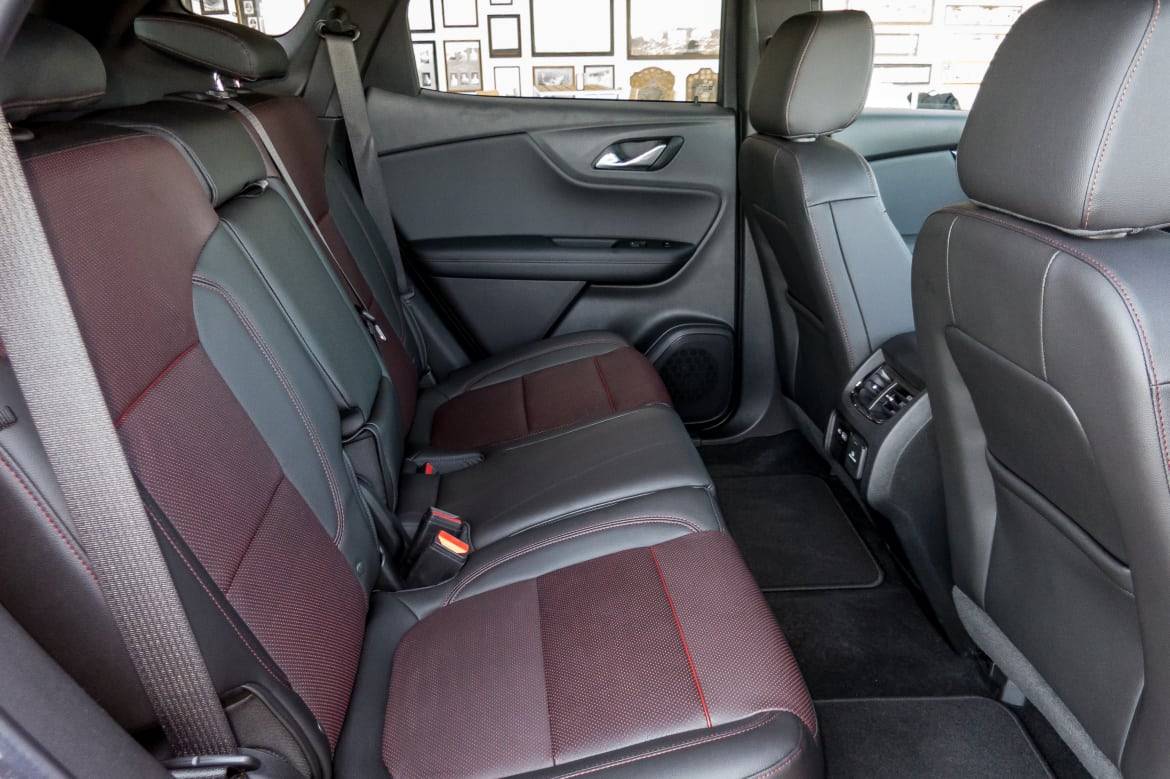
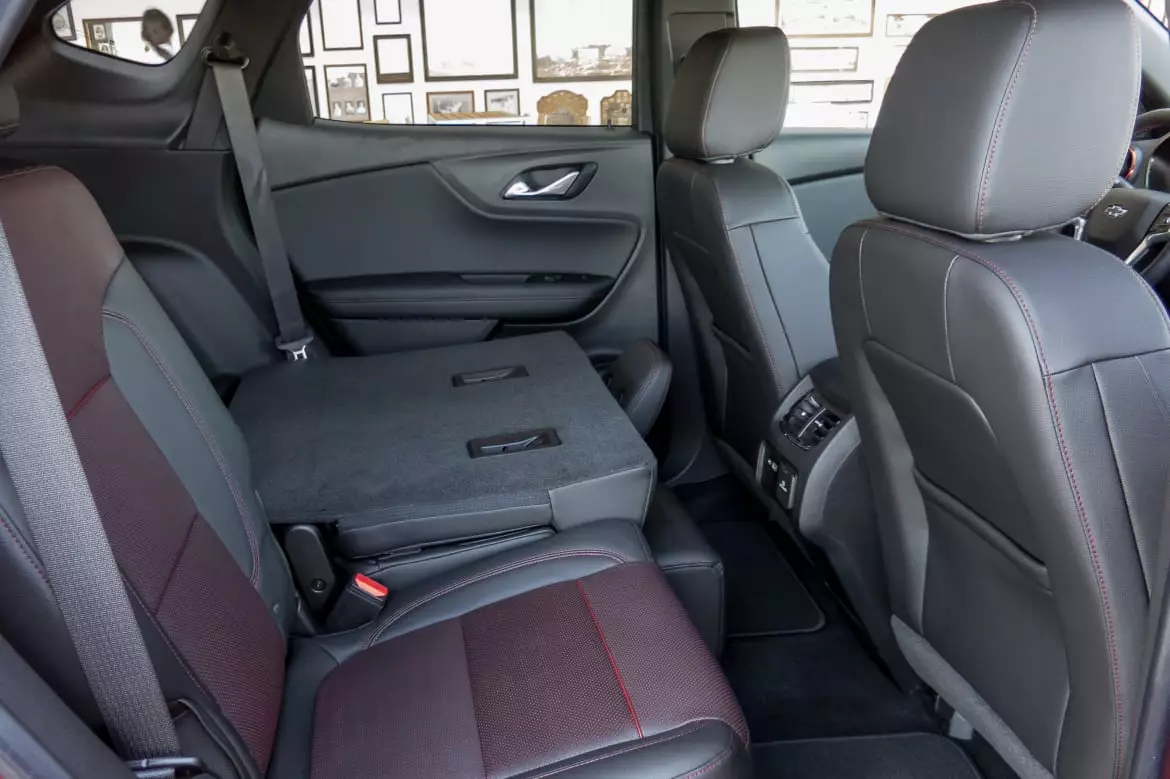
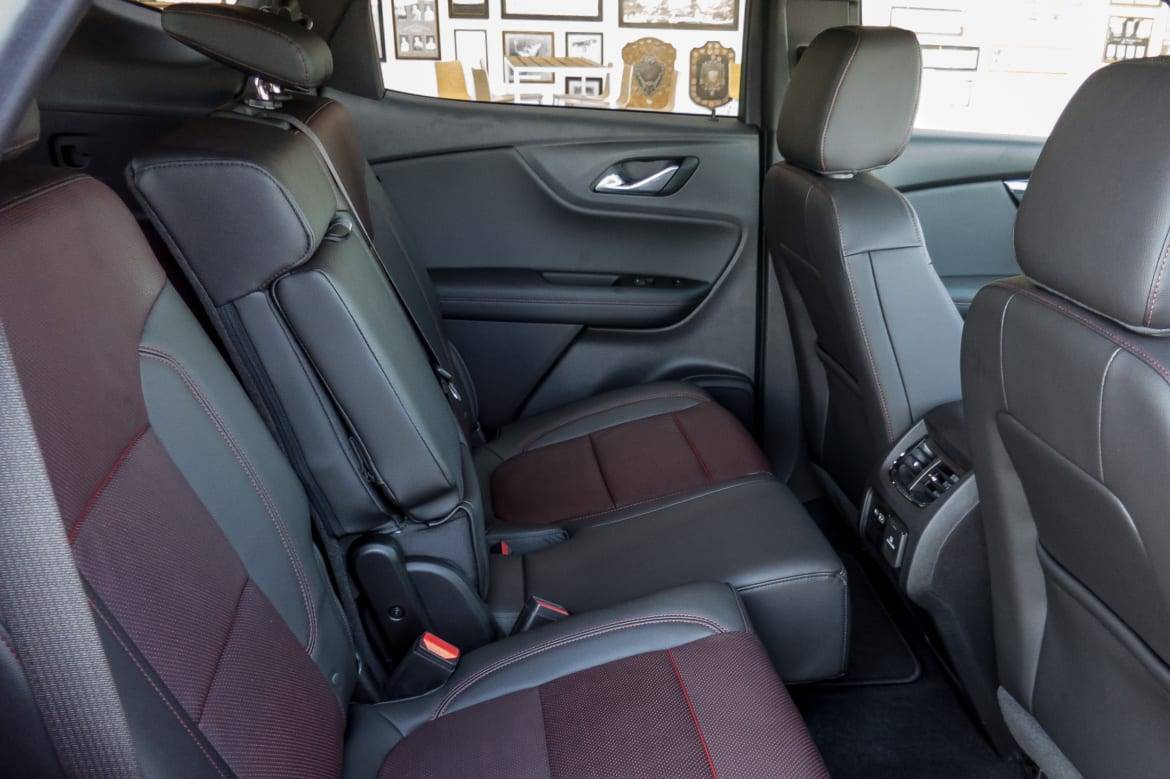
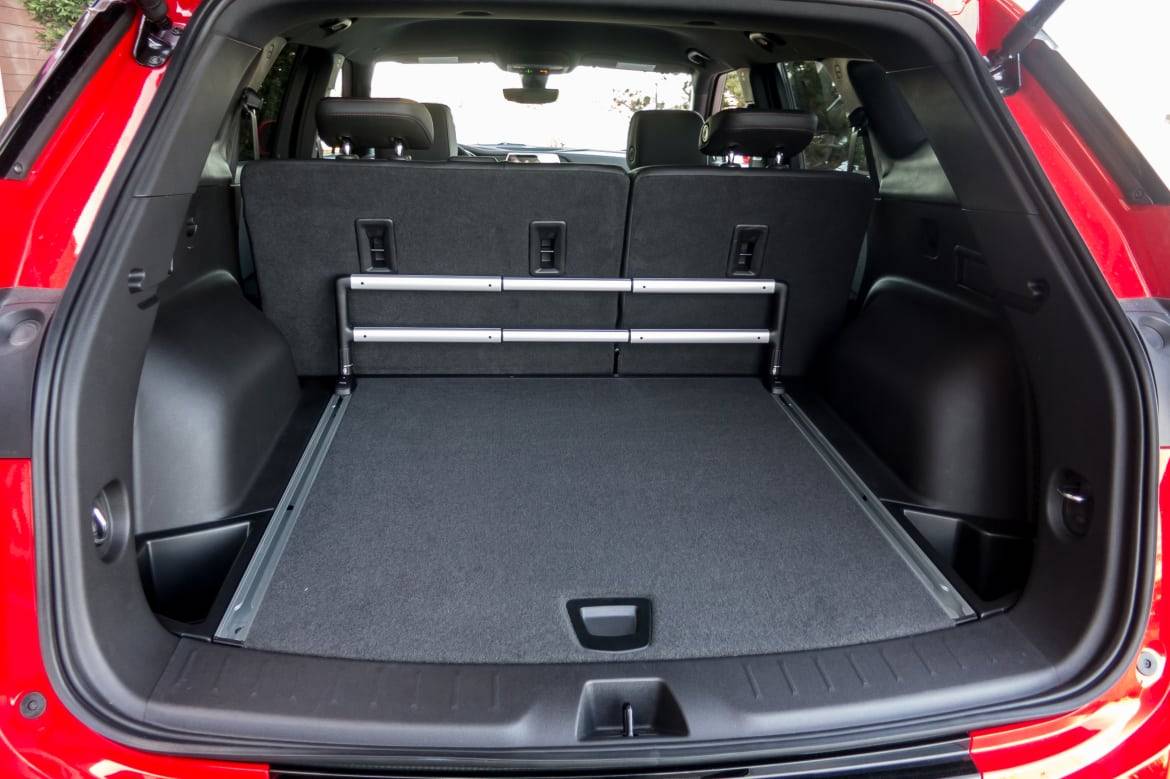
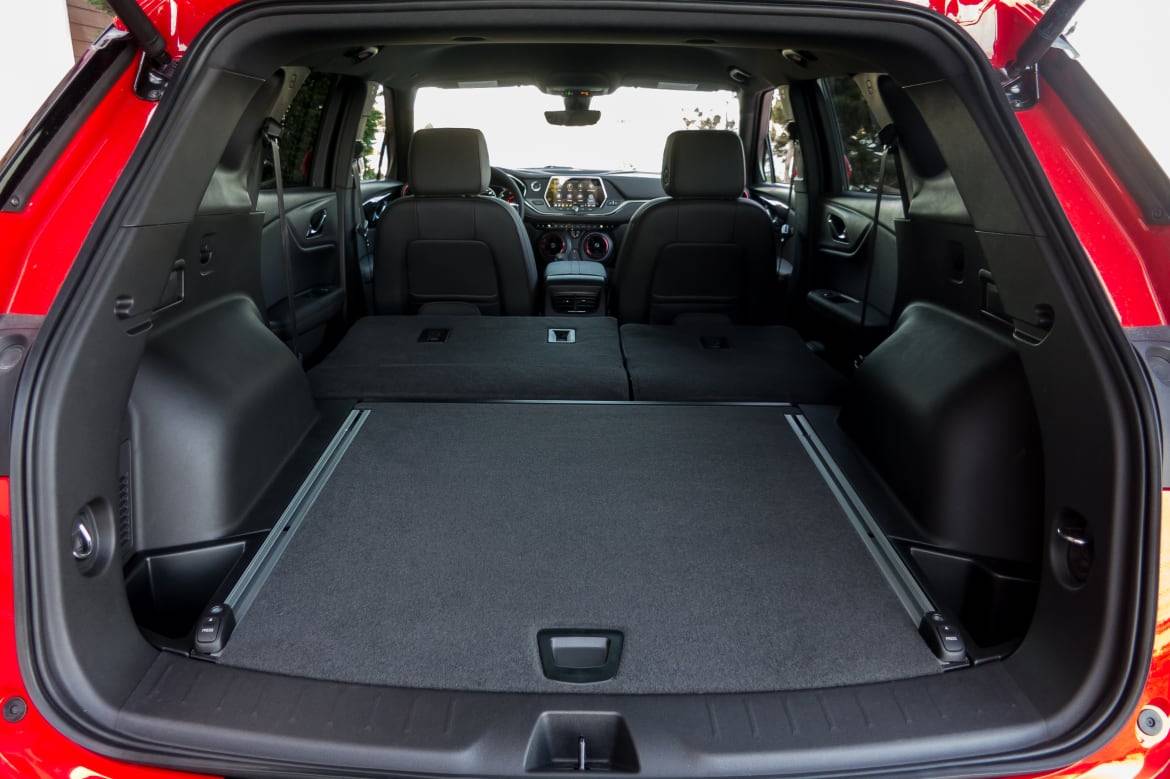
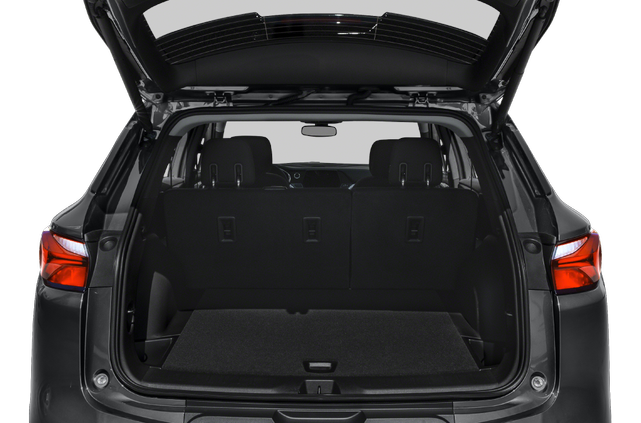
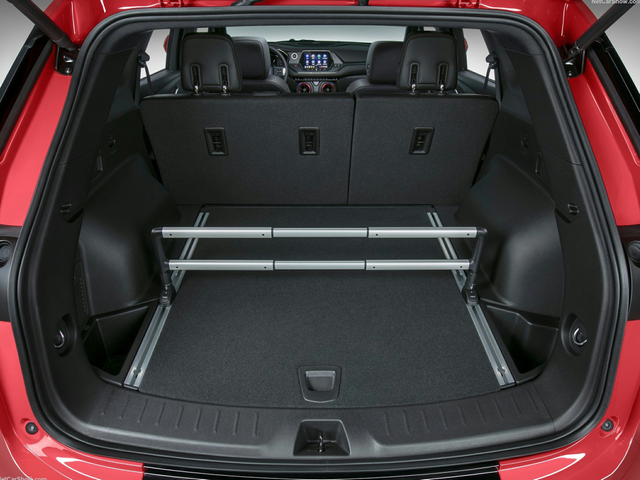
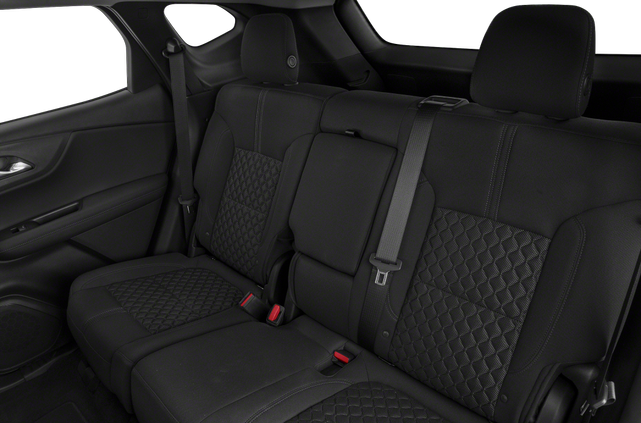
There’s a surprising amount of room inside the Blazer — plenty for four occupants (five might be a pinch due to the narrow-feeling bench backseat). The backseat slides forward and back, but it’s obvious the Blazer prioritizes passenger room over cargo space, as it features one of the smaller cargo areas among its competitors. The Blazer has 30.5 cubic feet of space behind the backseat, expandable to 64.2 cubic feet with it folded down. The Ford Edge has 39.2 cubic feet, expandable to 73.4 cubic feet, while the Nissan Murano has 31.1 cubic feet in back and 67.0 cubic feet maximum. Honda lists some rather curious numbers for a vehicle roughly the same size as the other three: It says the Passport has 41.2 cubic feet of cargo space behind the backseat, expandable to 77.5 cubic feet overall in a vehicle shorter than the Blazer.

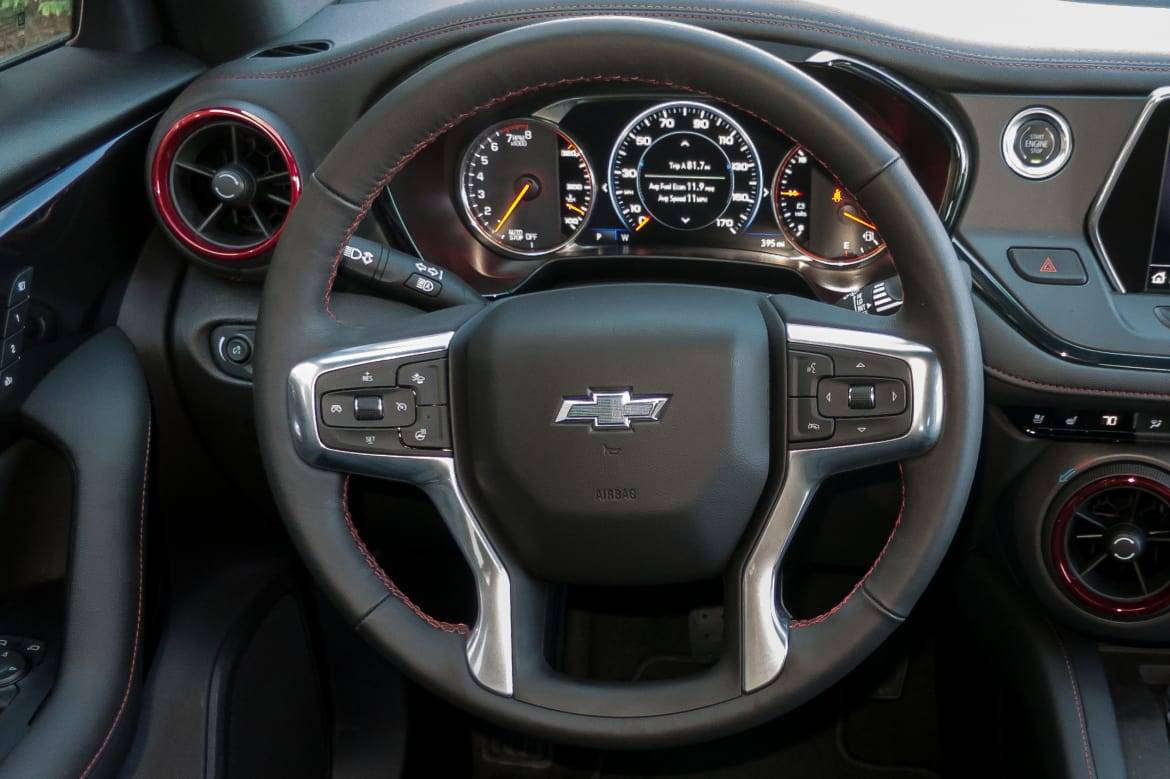
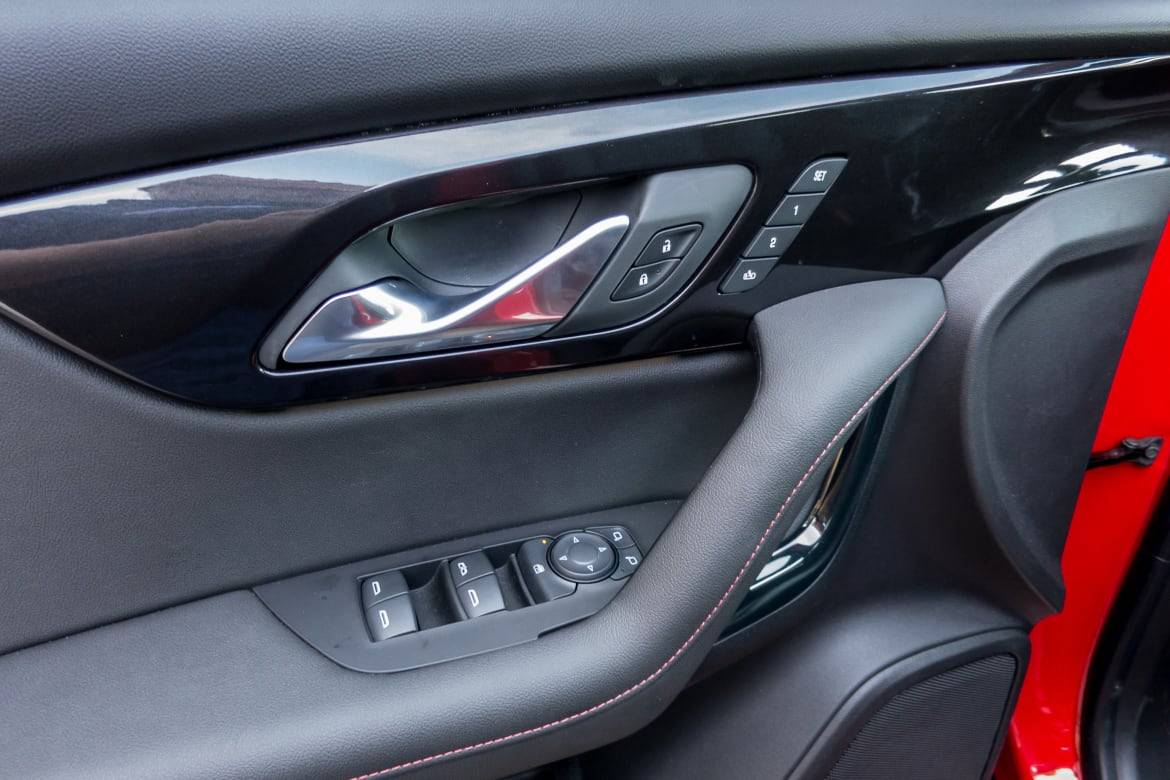
Gripes with the interior are few, but they do exist. Most prominent is the problem with all GM interiors lately: materials quality. Some of it is perfectly fine — the dash, for instance, looks and feels good, as do the controls and touchscreen. But the door panels feature the same cheap, thin plastic trim and hard door tops as the Camaro, and plastic quality falls off dramatically in the backseat as well. It doesn’t have the more upscale look and feel of today’s Honda products, but it matches up well to the latest Nissan Murano and Hyundai Santa Fe. My other gripe is with the steering wheel, which feels rather thin compared with some competitors’ vehicles. There are no molded grippy parts to fit your hands, and I wonder why Chevy didn’t opt for something more similar to the Camaro; it would have been an easy addition to the RS to further improve its sporting character.

The Value Problem

Starting price for the new Blazer is a tick less than $30,000 including destination fee, while a loaded AWD Premier tops off around the $54,000 mark. That’s pretty much spot-on for Chevrolet’s stated competition, which includes the Nissan Murano, Hyundai Santa Fe, Ford Edge and even potentially the Jeep Grand Cherokee (we’re not quite sure this one fits, however, Chevy marketing folks).

The thing is, when you start exploring the upper end of this price spectrum, while $46,000 can get you a well-equipped Blazer RS, it can also get you a well-equipped Edge ST that will satisfy sports SUV enthusiasts in much more rapid fashion. The Premier, however, is more of a matchup for the premium trims of these competitors, putting Chevy squarely in the hunt for stylish-two-row-SUV shoppers.

The bigger issue comes when you start comparing what you get in lesser Blazers with their competition. The least expensive AWD Blazer requires the V-6 and is priced at $37,195 — nearly $5,000 more than the least expensive Nissan Murano or Ford Edge with AWD. Here’s the real kicker: The Hyundai Santa Fe offers an AWD four-cylinder version for less money than the least expensive Blazer of any kind.

The Blazer is otherwise priced similarly to the Murano, Edge and Santa Fe when you consider the range in which it operates, though the equipment list looks very different across competitors. For instance: Want automatic emergency braking, a modern safety feature that comes standard in a lot of new vehicles? It’s standard on the Edge ($31,090) and Santa Fe (which starts less than $30,000), and the Murano has it standard for just about $32,000. But if you want it on the Blazer, you’ll have to pony up for either the RS or Premier trim level and then select it in a package, so the cheapest Blazer with automatic emergency braking is a $45,370 FWD RS. That’s about $15,000 more than the least expensive Edge or Santa Fe with this technology. Compare the Blazer with its competitors here.

So the value question is a valid one for the Blazer. Chevy’s strategy of providing big discounts, however, may equalize that when it comes time to visit a dealer. The brand has crafted a worthy competitor in the segment, however, so the Blazer’s success or failure won’t be from its lack of ability.

Cars.com’s Editorial department is your source for automotive news and reviews. In line with Cars.com’s long-standing ethics policy, editors and reviewers don’t accept gifts or free trips from automakers. The Editorial department is independent of Cars.com’s advertising, sales and sponsored content departments.

Detroit Bureau Chief

I handle new car reviews, news, events, auto shows, and contribute to special projects and multicar comparisons while representing our team in the heart of the U.S. auto industry. I’ve been a part of the industry my whole life, growing up in an automotive family, spending the past 30 years working for Bosch and Nissan, and serving as an industry analyst for years before coming to Cars.com in 2012. I’m a graduate of the University of Michigan (Go Blue!), have an MBA from Wayne State University in Detroit with a focus on international business strategy, and I’m a member of both the Automotive Press and the Midwest Automotive Media associations. My personal fun car is a pristine 2002 Ford Thunderbird, which I love because it is not an SUV, has zero touchscreens, and nothing dings at you all the time. My pronouns are he/him, but my adjectives are fat/sassy.

2020 Chevrolet Blazer review: Our expert's take
2020 Chevrolet Blazer 2020 Chevrolet Blazer 2020 Chevrolet Blazer 2020 Chevrolet Blazer 2020 Chevrolet Blazer 2020 Chevrolet Blazer 2020 Chevrolet Blazer 2020 Chevrolet Blazer 2020 Chevrolet Blazer 2020 Chevrolet Blazer 2020 Chevrolet Blazer 2020 Chevrolet Blazer 2020 Chevrolet Blazer 2020 Chevrolet Blazer 2020 Chevrolet Blazer 2020 Chevrolet Blazer 2020 Chevrolet Blazer 2020 Chevrolet Blazer 2020 Chevrolet Blazer 2020 Chevrolet Blazer 2020 Chevrolet Blazer 2020 Chevrolet Blazer 2020 Chevrolet Blazer

The verdict: Chevrolet has built the SUV-obsessed 21st century’s answer to the traditional family sports sedan.

Versus the competition: Competitors generally feature a lot more standard safety equipment and all-wheel drive at lower prices, but they don’t look this good. Though if sporting ability is really what you’re going for — not just sporty looks — it’s hard to top the Ford Edge ST’s twin-turbocharged muscle.

When Chevrolet first announced it would bring back the “Blazer” name and slap it on an SUV, four-wheel-drive enthusiasts around the country were thrilled: Was Chevy going to get back into the true off-road SUV game thanks to the perennial popularity of the Jeep Wrangler and the mad interest in the still-unseen, upcoming 2020 Ford Bronco? Turns out, the answer was “no.” When the 2019 Chevrolet Blazer was unveiled at a private event in the summer of 2018, we saw not a rugged off-roader at all, but rather a stylish, sporty, two-row, five-seat crossover SUV meant to challenge the Ford Edge, Hyundai Santa Fe and Nissan Murano.

Admittedly, the move makes sense. Mid-size SUVs like the new Blazer are the second-hottest-growing segment in the market (behind compact SUVs like Chevrolet’s own Equinox), so having an entry here — bringing the crossover count in Chevy showrooms up to four (Blazer, Equinox, Trax and Traverse) — couldn’t hurt. But does the market need another crossover-style SUV? Is the Blazer good enough to carve off buyers from its popular competitors?

The Sports Sedan Crossover

There’s no denying the Blazer makes a statement. There’s a presence to its styling that sets it apart in a field of boring two-box designs. The Chevrolet Camaro influences are obvious, from the swoopy front end to the prominent fenders, then reaching back to the sleek, angular taillights. An RS trim in bright red is without a doubt the sportiest looking crossover SUV in the class. While other competitors go for the rugged off-roader look, the Blazer makes no apologies about being an on-road warrior. And this makes sense: Crossovers are replacing sedans as the family vehicle of choice in America, so what should you get if you typically enjoy a sports sedan? Asks Chevy: How about a sports crossover?

2020 Chevrolet Blazer 2020 Chevrolet Blazer 2020 Chevrolet Blazer 2020 Chevrolet Blazer 2020 Chevrolet Blazer 2020 Chevrolet Blazer 2020 Chevrolet Blazer

More Substantial Than Expected

The biggest surprise of the Blazer is how much more substantial it feels than the Equinox. It has a more sophisticated chassis, using a McPherson strut front suspension and a five-link rear; it sits on the same one as the GMC Acadia, Cadillac XT5 and XT6. It’s wider than the Equinox and almost as wide as the much larger Traverse, which lends the Blazer a sense of stability and heft over all types of road surfaces. Chevy engineers did some amazing work isolating the Blazer from road imperfections, even with the optional 21-inch wheels. The steering has weight to it and body control is excellent, with very little wallowing in corners or undue motions that can translate into an unpleasant ride experience. This surprisingly substantial-feeling SUV’s road manners are easily a match for the Ford Edge or Nissan Murano.

Two powertrains are offered. The standard setup is a 2.5-liter four-cylinder Ecotec engine making 193 horsepower and 188 pounds-feet of torque, mated to a nine-speed automatic transmission that drives the front wheels. (All-wheel drive is not an option with the four-cylinder engine.) That four-cylinder is a perfectly fine powertrain choice; its lighter weight and lack of AWD equipment create a sprightly nimble feel. Acceleration is brisk even when getting on the highway, though it might be another story when loaded up with people and stuff. At roughly 3,800 pounds, the four-cylinder Blazer has a roughly 400-pound weight advantage over the AWD V-6 model, according to Chevrolet engineers, and that manifests in its handling and ride.

The other powertrain is GM’s ubiquitous 3.6-liter “Generation II High Feature” V-6, making 308 hp and 270 pounds-feet of torque, also mated to the nine-speed automatic. You can have it in regular, Premier or RS flavors. Chevrolet is taking a page out of Cadillac’s playbook, offering the top versions of the Blazer in two themes: luxury if you get the Premier trim, sport if you opt for the RS. All-wheel drive is optional on the V-6 Blazer, and a more sophisticated twin-clutch AWD system can be had on the Premier and RS.

The V-6 model is decidedly heavier, but it doesn’t feel poky or slow, just more substantial and solid. Acceleration is quick, but it doesn’t have the snappy torque curve of some rivals’ turbocharged four-cylinder engines. What it does enable is a 4,500-pound maximum towing capacity when properly equipped. The Premier trim feels just as solid and substantial as the base four-cylinder Blazer, with the added benefit of some extra grunt when you plant your right foot, accompanied by a muted growl.

Fuel economy takes a bit of a hit when you upgrade the engine. The Blazer is EPA-rated 22/27/24 mpg city/highway/combined for the four-cylinder model, dropping to 20/26/22 mpg for the FWD V-6 and 18/25/21 mpg for the AWD V-6. I put more than 500 miles on a Blazer RS V-6 and averaged 21.5 mpg overall — not a great number for a crossover with a nine-speed automatic and non-defeatable engine stop-start. The Blazer’s rating matches the V-6 Jeep Grand Cherokee 4×4, but it isn’t quite as good as the AWD Nissan Murano V-6 with its continuously variable automatic transmission, which rates 20/28/23 mpg, or the significantly more powerful Ford Edge ST’s 2.7-liter twin-turbo V-6, which comes in at 19/26/21 mpg.

There are a few drive modes to select from, including one that disconnects the AWD system for slightly better fuel economy. There’s a Sport mode that changes a few parameters, including AWD torque distribution but surprisingly leaving out throttle response and shift patterns for the transmission. Off-Road mode adjusts throttle response, but given the lack of significant ground clearance or underbody protection, I wouldn’t recommend taking a Blazer anywhere but a dirt road. Finally, a Tow/Haul mode holds on to lower gears longer for better response while hauling a trailer.

Sporting Pretenses

While the Premier version amps up the luxury quotient, the RS is the more dramatic of the Blazers. It adds more than just an appearance package, as we’ve seen on previous Chevrolets; it’s more like the Traverse’s RS trim level in terms of the visual and parts changes. While it doesn’t get a unique engine, like the Traverse RS has, it does receive some significant suspension and steering changes to alter its demeanor: The front struts get 40 percent more compression control, while the rear shocks improve by 15 percent. The steering ratio is quicker —  a 15-to-1 ratio instead of other Blazers’ 16-to-1 ratio. The twin-clutch AWD allows torque to be transferred side to side in addition to front to back, and 21-inch wheels are optional.

All this together gives the RS a more sporting character despite it not having more power to play with. Body control remains impressive, but the quicker-ratio steering is barely noticeable. The changes don’t make the RS all that sporty, and it certainly can’t hold a candle to the performance delivered by a Ford Edge ST, which has more than 100 pounds-feet of torque superiority from its twin-turbocharged engine. This makes the RS the choice to make if you just want the styling flash it offers; the almost European-feeling ride and handling combination is mostly a bonus. Otherwise, the Premier is a perfectly acceptable (if more expensive) option.

Camaro-Influenced Cockpit

2020 Chevrolet Blazer 2020 Chevrolet Blazer 2020 Chevrolet Blazer 2020 Chevrolet Blazer 2020 Chevrolet Blazer 2020 Chevrolet Blazer 2020 Chevrolet Blazer

Regardless of which Blazer trim level you get, the interior shows direct influence from the Camaro sports coupe — and it’s a successful integration. The dash design is appealingly sporty, and anyone fond of the Camaro’s layout will find a lot to like in here, too, from the placement of the multimedia screen to the round vent rings that also control temperature settings. The buttons are artfully located and everything is easy to use, and we applaud Chevrolet for not removing the height-adjustable shoulder belts in the Blazer, as it’s done with just about every other new Chevy that’s come down the pike recently.

2020 Chevrolet Blazer 2020 Chevrolet Blazer 2020 Chevrolet Blazer

There’s a surprising amount of room inside the Blazer — plenty for four occupants (five might be a pinch due to the narrow-feeling bench backseat). The backseat slides forward and back, but it’s obvious the Blazer prioritizes passenger room over cargo space, as it features one of the smaller cargo areas among its competitors. The Blazer has 30.5 cubic feet of space behind the backseat, expandable to 64.2 cubic feet with it folded down. The Ford Edge has 39.2 cubic feet, expandable to 73.4 cubic feet, while the Nissan Murano has 31.1 cubic feet in back and 67.0 cubic feet maximum. Honda lists some rather curious numbers for a vehicle roughly the same size as the other three: It says the Passport has 41.2 cubic feet of cargo space behind the backseat, expandable to 77.5 cubic feet overall in a vehicle shorter than the Blazer.

2020 Chevrolet Blazer 2020 Chevrolet Blazer 2020 Chevrolet Blazer 2020 Chevrolet Blazer

Gripes with the interior are few, but they do exist. Most prominent is the problem with all GM interiors lately: materials quality. Some of it is perfectly fine — the dash, for instance, looks and feels good, as do the controls and touchscreen. But the door panels feature the same cheap, thin plastic trim and hard door tops as the Camaro, and plastic quality falls off dramatically in the backseat as well. It doesn’t have the more upscale look and feel of today’s Honda products, but it matches up well to the latest Nissan Murano and Hyundai Santa Fe. My other gripe is with the steering wheel, which feels rather thin compared with some competitors’ vehicles. There are no molded grippy parts to fit your hands, and I wonder why Chevy didn’t opt for something more similar to the Camaro; it would have been an easy addition to the RS to further improve its sporting character.

The Value Problem

Starting price for the new Blazer is a tick less than $30,000 including destination fee, while a loaded AWD Premier tops off around the $54,000 mark. That’s pretty much spot-on for Chevrolet’s stated competition, which includes the Nissan Murano, Hyundai Santa Fe, Ford Edge and even potentially the Jeep Grand Cherokee (we’re not quite sure this one fits, however, Chevy marketing folks).

The thing is, when you start exploring the upper end of this price spectrum, while $46,000 can get you a well-equipped Blazer RS, it can also get you a well-equipped Edge ST that will satisfy sports SUV enthusiasts in much more rapid fashion. The Premier, however, is more of a matchup for the premium trims of these competitors, putting Chevy squarely in the hunt for stylish-two-row-SUV shoppers.

The bigger issue comes when you start comparing what you get in lesser Blazers with their competition. The least expensive AWD Blazer requires the V-6 and is priced at $37,195 — nearly $5,000 more than the least expensive Nissan Murano or Ford Edge with AWD. Here’s the real kicker: The Hyundai Santa Fe offers an AWD four-cylinder version for less money than the least expensive Blazer of any kind.

The Blazer is otherwise priced similarly to the Murano, Edge and Santa Fe when you consider the range in which it operates, though the equipment list looks very different across competitors. For instance: Want automatic emergency braking, a modern safety feature that comes standard in a lot of new vehicles? It’s standard on the Edge ($31,090) and Santa Fe (which starts less than $30,000), and the Murano has it standard for just about $32,000. But if you want it on the Blazer, you’ll have to pony up for either the RS or Premier trim level and then select it in a package, so the cheapest Blazer with automatic emergency braking is a $45,370 FWD RS. That’s about $15,000 more than the least expensive Edge or Santa Fe with this technology. Compare the Blazer with its competitors here.

So the value question is a valid one for the Blazer. Chevy’s strategy of providing big discounts, however, may equalize that when it comes time to visit a dealer. The brand has crafted a worthy competitor in the segment, however, so the Blazer’s success or failure won’t be from its lack of ability.

Cars.com’s Editorial department is your source for automotive news and reviews. In line with Cars.com’s long-standing ethics policy, editors and reviewers don’t accept gifts or free trips from automakers. The Editorial department is independent of Cars.com’s advertising, sales and sponsored content departments.
Safety review

Based on the 2020 Chevrolet Blazer base trim
NHTSA crash test and rollover ratings, scored out of 5.
Overall rating
5 out of 5
Combined side rating front seat
5 out of 5
Combined side rating rear seat
5 out of 5
Frontal barrier crash rating driver
5 out of 5
Frontal barrier crash rating passenger
4 out of 5
Overall frontal barrier crash rating
5 out of 5
Overall side crash rating
5 out of 5
Rollover rating
4 out of 5
Side barrier rating
5 out of 5
Side barrier rating driver
5 out of 5
Side barrier rating passenger rear seat
5 out of 5
Side pole rating driver front seat
5 out of 5
15.5%
Risk of rollover
Side barrier rating driver
5 out of 5
Side barrier rating passenger rear seat
5 out of 5
Side pole rating driver front seat
5 out of 5
15.5%
Risk of rollover

Factory warranties

New car program benefits

Basic
3 years / 36,000 miles
Corrosion
3 years / 36,000 miles
Powertrain
5 years / 60,000 miles
Roadside Assistance
5 years / 60,000 miles

Certified Pre-Owned program benefits

Age / mileage
10 years or newer / up to 100,000 miles
Basic
12 months / 12,000 miles Bumper-to-Bumper Limited
Dealer certification
126-point inspection

Compare similar vehicles

Select cars to compare for more detailed info.
  • 2020
    4.6
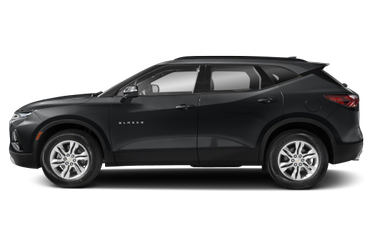
    Chevrolet Blazer
    Starts at
    $28,800
    MPG
    21 City / 27 Hwy
    Seat capacity
    5
    Engine
    Gas I4
    Drivetrain
    Front-wheel drive
    Compare
  • 2020
    4.5
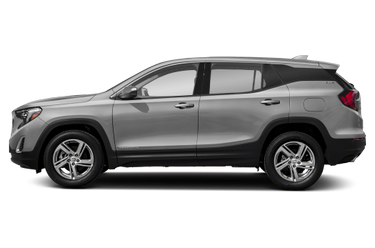
    GMC Terrain
    Starts at
    $25,000
    MPG
    26 City / 30 Hwy
    Seat capacity
    5
    Engine
    Turbocharged Gas/E15 I4
    Drivetrain
    Front-wheel drive
    Compare
  • 2022
    4.4
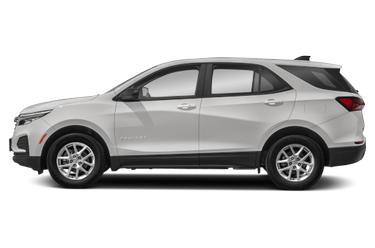
    Chevrolet Equinox
    Starts at
    $26,300
    MPG
    26 City / 31 Hwy
    Seat capacity
    5
    Engine
    Turbocharged Gas I4
    Drivetrain
    Front-wheel drive
    Compare
  • 2019
    4.2
    Chevrolet Blazer
    Starts at
    $28,800
    MPG
    22 City / 27 Hwy
    Seat capacity
    5
    Engine
    Gas V6
    Drivetrain
    Front-wheel drive
    Compare
  • 2021
    4.6
    Chevrolet Trailblazer
    Starts at
    $19,000
    MPG
    28 City / 31 Hwy
    Seat capacity
    5
    Engine
    Gas I3
    Drivetrain
    Front-wheel drive
    Compare
  • 2020
    4.8
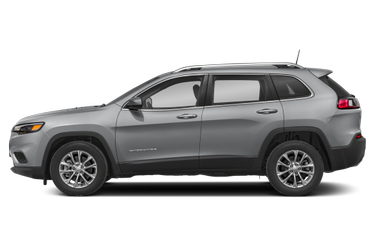
    Jeep Cherokee
    Starts at
    $25,840
    MPG
    22 City / 31 Hwy
    Seat capacity
    5
    Engine
    Regular Unleaded V-6
    Drivetrain
    Front-wheel drive
    Compare
  • Compare more options
    Use our comparison tool to add any vehicle of your choice and see a full list of specifications and features side-by-side.
    Try it now

Consumer reviews

4.6 out of 5
Based on 77 reviews
Write a review
Comfort
4.7 out of 5
Interior
4.6 out of 5
Performance
4.7 out of 5
Value
4.4 out of 5
Exterior
4.8 out of 5
Reliability
4.6 out of 5

Most recent

  • Bough this Blazer brand new in June of 2020 and it has

    Bough this Blazer brand new in June of 2020 and it has been very reliable with zero issues. All we have done is change the oil and rotate the tires on schedule. I am 6' tall with a prosthetic leg and I can get in and out with minimum struggles, whereas vehicle is driven mostly by my wife as a grandkid hauler on a regular basis with no complaints from her about anything save a TPS module failing in one tire. We did opt to get the 3.6L V-6 and what a powerful engine, 308 HP that leaves no want for more power. I did get a de-activator for the active fuel management system. I am concerned about camshaft and lifter failure as a known issue with this engine down the road. Also have heard and read about timing chain issues that will need to be replaced between 80k miles and 120k miles. This is a wear part that will need to be dealt with but remains much less than the sales tax on a new vehicle.
    • Purchased a New car
    • Used for Transporting family
    • Does recommend this car
    Comfort
    5.0 out of 5
    Interior
    5.0 out of 5
    Performance
    5.0 out of 5
    Value
    5.0 out of 5
    Exterior
    5.0 out of 5
    Reliability
    5.0 out of 5
    0 people out of 0 found this review helpful. Did you?
    Yes No
  • Transmission issues also electrical problems

    Transmission issues also electrical problems Transmission was replaced by dealer 2 times and the third is out again not good at all start stop short
    • Purchased a New car
    • Used for Transporting family
    • Does recommend this car
    Comfort
    4.0 out of 5
    Interior
    5.0 out of 5
    Performance
    4.0 out of 5
    Value
    5.0 out of 5
    Exterior
    5.0 out of 5
    Reliability
    2.0 out of 5
    1 person out of 1 found this review helpful. Did you?
    Yes No
  • Never will I spend money at this place!

    Never will I spend money at this place! Went here to buy a vehicle with cash money. So the salesman lied to me about a vehicle was there. But the truck was sold on Oct 26th. Had me coming driving there for no reason
    • Purchased a Used car
    • Used for Commuting
    • Does not recommend this car
    Comfort
    1.0 out of 5
    Interior
    1.0 out of 5
    Performance
    1.0 out of 5
    Value
    1.0 out of 5
    Exterior
    1.0 out of 5
    Reliability
    1.0 out of 5
    0 people out of 1 found this review helpful. Did you?
    Yes No
  • This SUV is solid in almost every way, but if I had to

    This SUV is solid in almost every way, but if I had to have any complaints I would say: *The design isn't really original, or even "Blazerish". Do I really care? No, but it's just kind of the reality that it doesn't look a lot different than the Equinox, Traverse, and many other vehicles by other manufacturers. Anyway just saying that they could have tried a little harder to have a signature defining figure to separate from everyone else. *The other complaint is that it doesn't have a CD player. Like who decided to save $100, and not put one in? Some Gen Z kid? Again, I see that a lot of cars are this way, but it's just being forced on us by this young crop of kids...At the very minimum take a survey to see who would elect to have one put in, or elect to have one not put in...people are just going with it
    • Purchased a Used car
    • Used for Commuting
    • Does recommend this car
    Comfort
    5.0 out of 5
    Interior
    5.0 out of 5
    Performance
    5.0 out of 5
    Value
    5.0 out of 5
    Exterior
    5.0 out of 5
    Reliability
    5.0 out of 5
    0 people out of 0 found this review helpful. Did you?
    Yes No
  • We love our Blazer with the comfortable ride (18”wheels)

    We love our Blazer with the comfortable ride (18”wheels) and huge sun roof! The car body and styling look better than most other cars on the road. The performance is always reliable when you need to merge into traffic. Seats are comfortable and can be adjusted to fit every body. I look forward to driving this car every time I leave home. The doors are easy to close and multi, multi choice wipers are great. This is not a family car for kids and junk but adults are comfy in it.
    • Purchased a Used car
    • Used for Commuting
    • Does recommend this car
    Comfort
    5.0 out of 5
    Interior
    4.0 out of 5
    Performance
    5.0 out of 5
    Value
    4.0 out of 5
    Exterior
    5.0 out of 5
    Reliability
    5.0 out of 5
    0 people out of 0 found this review helpful. Did you?
    Yes No
  • Regret Purchase

    Had to replace the air conditioner at 24,000 miles . Latest problem , sometimes when I shift into park , I cannot turn car off because warning indicator light says I am not in park . Have to repeatedly shift back and forth between drive and park for it to finally turn off . Car now has 27, 000 miles .
    • Purchased a New car
    • Used for Transporting family
    • Does not recommend this car
    Comfort
    4.0 out of 5
    Interior
    5.0 out of 5
    Performance
    4.0 out of 5
    Value
    1.0 out of 5
    Exterior
    5.0 out of 5
    Reliability
    1.0 out of 5
    8 people out of 9 found this review helpful. Did you?
    Yes No
  • Safety hazard

    I am 5’3”, its hard to see over dash! The seat doesnt raise enough to have a clear view out the front! Its hard to know where the front of the car is when parking if you dont have a front camera (I did not)! There are a lot of blind spots specifically on drivers side between front windshield and drivers window! Also when backing up, passenger side between passenger window and back window! I had many close calls with this car! I had it for 2 yrs and sold it! Beautiful car, love the interior has that cockpit feel! Height of windows is smaller which makes that cockpit feel more dominant! I had a 2.5 engine, took a few secs to really kick in when u floored it but Once the car got going, very smooth ride! Lots of leg room in rear and front! Nice size cargo area!
    • Purchased a New car
    • Used for Commuting
    • Does not recommend this car
    Comfort
    5.0 out of 5
    Interior
    5.0 out of 5
    Performance
    4.0 out of 5
    Value
    4.0 out of 5
    Exterior
    5.0 out of 5
    Reliability
    5.0 out of 5
    7 people out of 8 found this review helpful. Did you?
    Yes No
  • Ac compressor failure

    Purchased our new 2020 Chevy Blazer in 2019 .Car only has 22000 miles on it . We are both seniors and retired and so car is not driven often . Happy with everything about car until now . Loved the back up camera , rode fairly comfortably, and air conditioner worked great ! Until this past week . While driving home from shopping nearby the compressor locked up which caused drive belt to break . Car overheated . This should not be happening to a car with 22000 miles . Had to pay 3000 for repair as warranty covers 36000 miles or 3 years , whichever comes first .
    • Purchased a New car
    • Used for Having fun
    • Does not recommend this car
    Comfort
    4.0 out of 5
    Interior
    5.0 out of 5
    Performance
    4.0 out of 5
    Value
    3.0 out of 5
    Exterior
    5.0 out of 5
    Reliability
    2.0 out of 5
    15 people out of 16 found this review helpful. Did you?
    Yes No
  • 2020 bLAZER NEEED SOME FIXES FOR 2023 CARS

    Pros: Nice looking car . RS black on Black out rims wheels and full glass panoramic roof package Cons: Driver window down a bit the whole back hatch shakes had it n 2x already in between covid closes. Cameras on dash goes crazy and dosnt work now and then every few days. I have pics , also had it in a few times for this said it was fixed and wasnt. ALSO brakes squeak had it in earlier this year and was told to hit brakes hard so noise isnt as loud and long but otherwise OK I said I didnt think so and eventually we will call chevy corporate to see of can be resolved. The one time I got a loaner was from a rental that was not on premises and took 3 hours to drive off with a car 1/3 thw size of mine and then the car rental charged me tolls and fee on my credit card when I never left LI just went to work and home. Heated seat are horrible im already halfway accross suffolk county before you feel any worthy warmth like every other model chevy works and basically every other newer car with how other chevy model produce. I also mentioned that several times no resolve or effort to try . take car and gp oil ois o
    • Purchased a New car
    • Used for Transporting family
    • Does recommend this car
    Comfort
    4.0 out of 5
    Interior
    2.0 out of 5
    Performance
    4.0 out of 5
    Value
    2.0 out of 5
    Exterior
    3.0 out of 5
    Reliability
    3.0 out of 5
    10 people out of 12 found this review helpful. Did you?
    Yes No
  • Three Years and no problems with this vehicle

    We looked at a number of cars before we purchased our 2020 Blazer. Ours came with an awesome V-6 engine rated at 206 HP if I have it right. It has loads of power, 4 wheel drive with the option of 2WD for most days. It gets 23.6 MPG for our defined use. The sound isolation is amazing with a very quiet inside blocking most road noise. My wife loves this car. We got the 2LT version with the optional V-6 and Cajun red paint. GM has a winner with this vehicle.
    • Purchased a New car
    • Used for Commuting
    • Does recommend this car
    Comfort
    4.0 out of 5
    Interior
    5.0 out of 5
    Performance
    5.0 out of 5
    Value
    5.0 out of 5
    Exterior
    5.0 out of 5
    Reliability
    5.0 out of 5
    10 people out of 11 found this review helpful. Did you?
    Yes No
  • The RS is the way to go!

    Just purchased the 2020 RS and I’m in absolute love. This is my first SUV and it’s a great vehicle. It’s a super smooth ride and quiet. Nice acceleration too.
    • Purchased a Used car
    • Used for Having fun
    • Does recommend this car
    Comfort
    5.0 out of 5
    Interior
    5.0 out of 5
    Performance
    5.0 out of 5
    Value
    5.0 out of 5
    Exterior
    5.0 out of 5
    Reliability
    5.0 out of 5
    2 people out of 2 found this review helpful. Did you?
    Yes No
  • Styling good

    Brought the LT1 with 2.5L plenty of pep fuel mileage good, Only thing is Air conditioning controls hard to see when driving to many small designs has auto stop but can turn off. Ride is good transmission is 9 speed but really can't feel shifts smooth, engine is noisy on hard acceleration. Enjoying
    • Purchased a New car
    • Used for Having fun
    • Does recommend this car
    Comfort
    5.0 out of 5
    Interior
    4.0 out of 5
    Performance
    5.0 out of 5
    Value
    5.0 out of 5
    Exterior
    5.0 out of 5
    Reliability
    5.0 out of 5
    7 people out of 9 found this review helpful. Did you?
    Yes No

Latest Blazer stories

See all Chevrolet Blazer articles

Chevrolet dealers near you

FAQ

What trim levels are available for the 2020 Chevrolet Blazer?

The 2020 Chevrolet Blazer is available in 4 trim levels:

  • L (1 style)
  • LT (5 styles)
  • Premier (2 styles)
  • RS (2 styles)

What is the MPG of the 2020 Chevrolet Blazer?

The 2020 Chevrolet Blazer offers up to 21 MPG in city driving and 27 MPG on the highway. These figures are based on EPA mileage ratings and are for comparison purposes only. The actual mileage will vary depending on vehicle options, trim level, driving conditions, driving habits, vehicle maintenance, and other factors.

What are some similar vehicles and competitors of the 2020 Chevrolet Blazer?

The 2020 Chevrolet Blazer compares to and/or competes against the following vehicles:

Is the 2020 Chevrolet Blazer reliable?

The 2020 Chevrolet Blazer has an average reliability rating of 4.6 out of 5 according to cars.com consumers. Find real-world reliability insights within consumer reviews from 2020 Chevrolet Blazer owners.

Is the 2020 Chevrolet Blazer a good SUV?

Below are the cars.com consumers ratings for the 2020 Chevrolet Blazer. 87.0% of drivers recommend this vehicle.

4.6 / 5
Based on 77 reviews
  • Comfort: 4.7
  • Interior: 4.6
  • Performance: 4.7
  • Value: 4.4
  • Exterior: 4.8
  • Reliability: 4.6

Chevrolet Blazer history

Your list was successfully saved.


Save list Compare
[{"cat":"suv_midsize","stock_type":"used","bodystyle":"SUV","page_type":"research/make-model-year","oem_page":false,"search_fuel_types":["Gasoline Fuel"]}]